Miami is a prime destination for new food & beverage concepts

By staff writer

June 2019


Miami’s food and beverage sector is known for its diversity, and 2019 is expected to buttress that reputation, with numerous high-profile restaurants set to spice up the local scene. The arrival of international eateries that are making Miami their first U.S. location is also helping to prop up the economy.

“The tremendous growth we’ve observed (in the real estate market) can be attributed in part to the fact that Miami has become much more important culturally than it ever has been. Even in terms of restaurants, this market never had the selection it now has,” Jackie Soffer, CEO and chairman of real estate development group Turnberry Associates told Invest:. “For instance, we just opened a restaurant in the Aventura Mall with Ayesha Curry and Michael Mina, both well-known, nationally acclaimed chefs, called International Smoke,” she said. 

Restaurants are a driving force not only in Miami, but in Florida’s economy. According to a report from the National Restaurant Association, restaurant and food service jobs represent 12% of employment in the state. 

One of the most anticipated openings for fall 2019 is Orilla Bar & Grill, by Argentine chef Fernando Trocca. This will be the popular Argentine restaurant’s first location in the U.S. Trocca partnered with bartender Ines De Los Santo and restaurateur Martin Pittaluga, according to an article in Eater Miami. 

Esplanade at Aventura, an open-air shopping, dining and entertainment complex under construction, recently announced five restaurants that will debut their first U.S locations there. These eateries, which are set to open in spring 2020, are: Carolo and Blanco Bistro, both from Mexico; Jarana, the newest restaurant concept from Peruvian celebrity chef Gastón Acurio; SU Japanese, based on Brazilian-based restaurant Kitchin; and Mixtura Market Hall, which is the first food hall announced for the complex. Miami’s rich dining landscape offers options for every type of flavor, from Latin American to Pan-asian, Caribbean to Middle Eastern,

“There’s high demand in the restaurant industry: The Miami Modern (MiMo) area is continually growing and the whole Biscayne Corridor is changing because of its proximity to key areas such as the beach and downtown,” Michelle Gonzalez, Broker/Owner of Floridian First Realty, told Invest:. “There are other areas such as Kendall and Homestead that have space for growing their culinary offerings and where we’ll definitely see more restaurants opening up.” 

Gonzalez added that trendy restaurant concepts, such as juice bars and cafes, new hotels and breweries, are also reshaping Downtown Miami, including its look and feel. 

For more information about our interviewees, please visit: 

Turnberry Associates: https://www.turnberry.com/

Floridian First Realty: https://www.floridianfirstrealty.com/

National Restaurant Association: https://restaurant.org/Home


Baby boomer retirees keeping accountants, advisers busy

By staff writer

June 2019 — As the baby boomer generation retires from the workforce, the need for business succession planning continues to grow. This is keeping at least one group busy: accountants and advisers.


“Over the past few years, we’ve seen significant growth in the need for succession and exit planning services due to the concentration of businesses that are owned by baby boomers who are retiring on a daily basis,” Christopher Meshginpoosh, managing director of Kreischer Miller, told Invest:. “Many of the owners of our clients are trying to fill their bench of future leaders or determine which exit options make sense for them in light of their long-term goals,” he said.

Although boomers are staying longer in the workforce and they continue to drive the U.S. labor market, business owners who were born between 1946 and 1964 are having a hard time transitioning their companies to the next generation of owners. According to Deutsche Bank Research an estimated 10,000 people turn 65 each day, which is the standard age for retirement. The Census Bureau estimates that by 2030, all baby boomers will be older than age 65.

“There is potential for a talent void as baby boomers leave the workplace. This represents a tremendous opportunity for younger professionals as they are presented with more career opportunities,” James Bartolomei, Principal at HBK CPAs & Consultants, told Invest:.

The increased number of boomers retiring each day presents several challenges for employers, including the need to provide the right tools for every party involved in the transition process. “Companies need to make sure they have mentoring and training programs in place to allow a smooth and effective transition from one generation to another,” Bartolomei said.

Some accounting and advisory firms, such as Kreischer Miller, have seen a great deal of interest in the formation of employee stock ownership plans (ESOPs), which has driven them to develop a deep expertise in that area.

“In the right situations, ESOPs provide a tax-efficient method for owners to gradually transition ownership to their employees, allowing the business to continue to thrive as an independent organization,” Meshginpoosh said.

According to Generational Equity, there were some 12 million baby boomers who owned a business in 2015, and 70 percent will be retiring over the next couple decades.

Although the exit of the boomers from the workforce presents numerous challenges for the economy overall, it translates into opportunities for the youngest generations. Many Philadelphia accounting experts are positive about the market.

“The fundamentals that our clients are showing us are great. Earnings are good, the businesses are solid and they’re growing organically as well as through acquisitions. Overall, the Philadelphia economy is expanding and we’ll continue to see a lot of private equity pumped into the Philly market,” Christopher Bruner, managing partner of EY, told Invest:.

For more information about our interviewees visit:

Kreischer Miller: https://www.kmco.com/

HBK CPAs & Consultants: https://www.hbkcpa.com/

EY: https://www.ey.com/en_gl


Orlando Cashes in on the Experience Economy

By staff writer

June 2019When it comes to spending their hard-earned cash, people prioritize the experience. In a study conducted in the UK, just over 40% of respondents valued how their holiday will appear to their friends and families as the most important factor when choosing their destination. When it comes to Instagrammability, Orlando leads the pack.


The city’s hospitality and leisure sector has been feeding into the local economy for many years. Leisure and tourism was responsible for 20.1% of job growth in Orlando in December 2018, more than any other sector. But even as real disposable income per capita is growing, people are pickier about where they spend their hard-earned cash. They need the wow factor and that is where the Experience Economy comes in.

Orlando has long been synonymous with Disney. Think Orlando, think Mickey Mouse ears and the Magic Kingdom. But global theme park spending surged by 5% to a record $44.8 billion in 2018 and now everyone wants a piece of that pie.

“Orlando is also considered the No. 1 family destination in the US, if not the world, so right now, this city is kind of like the Super Bowl of our industry, where the big game is,” said Bill Davis, Universal Studios Orlando’s COO said in a media interview with Chief Executive.[CN2]

Universal, well aware of the importance of funnelling money into reimagining what the public really wants, has just launched a new experience in the Wizarding World of Harry Potter – a mind-bending alternative universe. The attraction, Hagrid’s Magical Creatures Motorbike

Adventure, opened on June 13 to huge crowds, 10-hour lineups and an ensemble of the movie franchise’s biggest stars.

“I was here back in 1987 when this was all still snake-filled marshland. And to see what it’s become — Central Florida’s newest destination resort — is just kind of mind-blowing,” said Tom Williams, Chairman and CEO of Universal Parks & Resorts said in a Huffington Post interview. “Orlando is the capital of Harry Potter.”[CN3]

Alongside Hagrid’s Magical Creatures, Universal also unveiled its Endless Summer “value” Surfside Inn and Suites resort, with rates starting at $73 per night. Universal is constructing the neighbouring Dockside Inn and Suites resort, which will add 2,050 rooms and suites in 2020.

But Hagrid’s Magical Creatures is just one of the upcoming additions to Universal Orlando. Late last year, NBCUniversal CEO Steve Burke pledged that parent company Comcast would invest more money in its theme park business than it spent to acquire NBCUniversal, which came in at a total of $30.1 billion.

Then, this February, Universal Orlando filed revised drawings to the Orange County authorities detailing an entire new theme park under development near the Orange County Convention Center. Work is already underway on the new site, reportedly called Fantastic Worlds.

With an entire theme park to build, entailing infrastructure, back of house, parking lots, and road expansions needed to support it, it looks like Universal is sticking to its pledge.

The company has deep pockets and isn’t afraid to dig into them, which is good news for its flagship Orlando destination. “We’re not going to stop there,” said Williams. “We’re going to keep going with new hotels and new attractions and give people from around the world lots of great reasons to come visit this destination.”

“It’s Official, Miami”

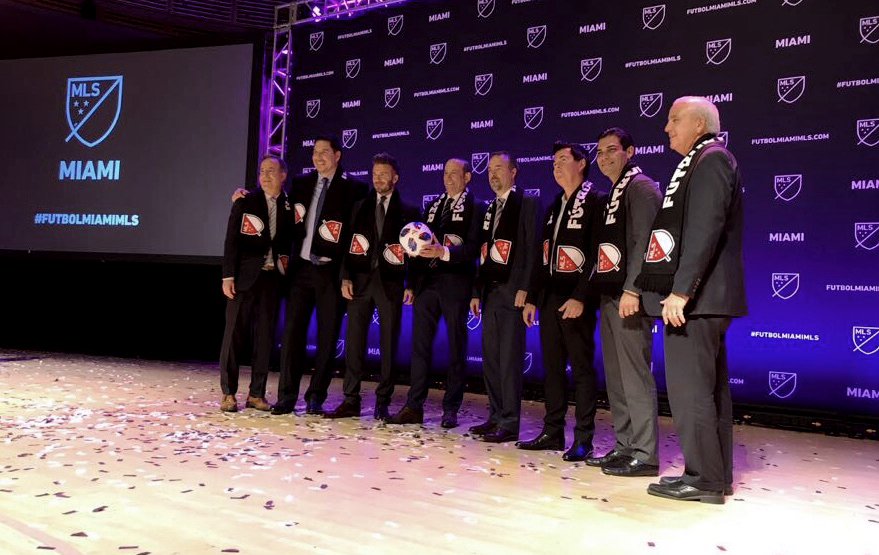
January 2018 — “Today you made my dream come true,” a giddy David Beckham, suited shoulders draped in an MLS scarf, told a small crowd gathered at the Adrienne Arsht Center on Monday, January 29.

After his first announcement four years ago fell through in the face of financing and stadium site challenges, Beckham’s dream of bringing an MLS expansion team to Miami is finally coming to fruition as the league made it official.

Beckham’s ownership group is planning to build a 25,000-seat, $225 million stadium in Overtown as the new home to Miami professional soccer. The stadium plan includes a training center and academy that will focus on developing local players. The team hopes to be deeply connected to the community — not just to the players but also to the fans. The goal is to grow locally in order to compete globally.

Miami has a complicated history with soccer. Its first MLS team, Miami Fusion, based out of Fort Lauderdale, flopped in 2001 after only a few short — and underwhelming — years. In a city known for its diversity and rich Latin American influence, it’s almost unfathomable that a futbol team isn’t already a huge part of its fabric. But while friendly matches bring out fans in droves, for some reason a home team hasn’t had the same impact.

Beckham and his co-owners hope to change that. Perhaps as they sort out the still-unannounced details — team name, colors, logo, start date — they should look to another team, in Capital Analytics’ Atlanta market, for some ideas on how to make a brand-new franchise shine virtually overnight.

In 2017, Atlanta United kicked off its inaugural season, and just five months after that first game, it had become MLS’s most popular team. It boasts the highest average home attendance in MLS history and better average home attendance than any MLS, NBA, NHL or MLB franchise in the country. Its opening weekend match was the best-attended game, by a factor of two, in the league.

Reports have suggested we would be the 24th team in Europe with our average attendance,” Darren Eales, president of Atlanta United, told Capital Analytics, “and for our first game of the season, we had an attendance of 55,000, which put us at the fourth most attended game in the world.”

So how did this team go from nothing to record-breaking so quickly? Two words: community investment. They spent a lot of time meeting with fans in bars, pre-selling season seats and generally pounding the pavement to spread the word.

“From day one, we wanted to create the feeling that this was a club centered on its fans,” Eales told Capital Analytics, “so we did a lot of grassroots events focused on international games and viewing parties. We decided that if we focus on our most dedicated fans, the rest will take care of itself.”  

They also spent some time making sure that the team would be worth watching, which included recruiting a talented coach and deeply investing in young players. Team owner Arthur Blank’s resources, such as commercial sponsorship and sales and marketing departments (he also owns the Falcons), didn’t hurt either.

If Beckham wants his Miami team to succeed, he will need to rely on more than his legendary right foot. Soccer is a collaborative sport, and the Miami MLS franchise will truly need to be a collaboration between the community and the team. All eyes on are on Fútbol Miami as the details get hammered out and we looked forward to opening day!

For more information on Beckham’s team, visit https://www.futbolmiamimls.com/
For more information on Atlanta United, visit https://www.atlutd.com/

The Healthcare Research Capital

February 2018 — Known as a healthcare hub, Atlanta is nationally recognized not only for its patient care but also for its research in the healthcare industry. As the home of the Centers for Disease Control and Prevention and leading research institutions like Emory University and Georgia Tech, Atlanta paves the way in innovation within the industry. In fact, former Mayor Kasim Reed said that Atlanta would become the health technology capital of the Southeast after seeing the impact that the recently opened Atlanta Center for Medical Research has had on its surrounding community.

Focus: Atlanta spoke with a number of city leaders in the healthcare sector to get their insights on this. Here’s what they said:

Dr. Jonathan Lewin, President and CEO and Chairman of the Board, Emory Healthcare

“At Emory’s Woodruff Health Sciences Center, we are conducting more than $540 million of externally funded research in 2017. The Emory Vaccine Center is performing clinical trials for Zika virus vaccines,  we have made groundbreaking progress on HIV vaccines and antibiotic resistance. The Winship Cancer Institute, recently designated a comprehensive cancer center by the National Cancer Institute, has participated in clinical trials for all the newest immunotherapy drugs. Our Brain Health Center is conducting research on Alzheimer’s, PTSD, stroke, and depression. We are leading the largest clinical trial ever in Atlanta, the Emory Health Aging Study, which will be enrolling healthy aging people across the city, looking at brain health development and dementia. It’s going to be one of the biggest trials ever conducted in the U.S. for brain health.”

Dr. Walter Curran, Executive Director, Winship Cancer Institute

“The National Cancer Institute considers several features of an institution when it designates CCCs. It looks at the quality of laboratory cancer research, the quality of clinical trials, the efforts to understand cancer in the community, including cancer prevention or early detection methods, educational training programs and the positive impacts of research on the local community. Our mission is to lessen the burden of cancer in Georgia. We do that by aligning our research and educational programs with our cancer care and prevention.”

Anne Meisner, CEO, Cancer Treatment Centers of America

“We have a presence of large academic institutions, and that is a driver of medical education as well as research.”

John Haupert, President and CEO, Grady Health System

“The Marcus Stroke and Neuroscience Center came online in 2010 and has become one of the leading stroke centers in the country. It is the largest in Georgia and a leading research facility. The Marcus Trauma Center has given us the capacity to manage larger numbers of trauma patients. Additional investments have been made in cardiology that allow Grady to be a 24-7 cardiac center and allow a 24-7 catheterization lab available to respond to ST-Elevation Myocardial Infarction, a serious type of heart attack. Most recently, we have undergone a significant expansion and renovation of our emergency department. Because of the population we serve, we have created the state’s first psychiatric ER as we see a significant number of psychiatric patients.”

To find out more about our interviewees above, visit their websites at:

Emory Healthcare: https://www.emoryhealthcare.org
Winship Cancer Institute: https://winshipcancer.emory.edu
Cancer Treatment Centers of America: https://www.cancercenter.com
Grady Health System: https://www.gradyhealth.org

Conventional Attraction


January 2018 — In 2017, Atlanta was host to a total of 700 conventions, meetings and events according to the Atlanta Convention & Visitors Bureau. Over the next five years, 107 additional conventions will be held in the Greater Atlanta area, 47 of which have never been held in the city. There are a number of factors that contribute to this.

Besides Atlanta’s favorable climate, variety of attractions and centralized metropolitan area, the Georgia World Congress Center Authority in downtown Atlanta is ranked the number 1 convention, sports and entertainment destination in the world. The GWCC’s “2020 Vision” consists of adding a new 100,000-square-foot exhibit hall, 48,000 square feet of new meeting space, a 20,000-square-foot lobby and a new 800- to 1,000-room hotel in order to continue to expand the tourism industry by attracting more meetings and conventions.

Another significant factor for the increasing number of conventions and meetings taking place in Atlanta is the easy connectivity promoted by the Hartsfield-Jackson Atlanta International Airport. Situated about a 2-hour flight from every major U.S. destination, Atlanta serves as the ideal place to facilitate centrally located meetings.

The city continues to promote itself in order to continue to attract more conventions and events to the area. However, despite all of Atlanta’s positive factors, there is still one problem: not enough space.

Focus: Atlanta spoke with a number of leaders in the city’s tourism industry to gain insights on how Atlanta plans to successfully attract and house more conventions. Here’s what they said:

William Pate, President and CEO, Atlanta Convention & Visitors Bureau

Over the next four to five years, we are going to see numerous conventions that haven’t been held here in almost a decade – some of which have never held their meeting here. A lot of conventions are now looking at Atlanta. We have a unique opportunity to show off our great city to these new meetings. If we can add some of these conventions to our current business rotation, we can see additional lift in our run rate. These are very exciting times for our destination and our hospitality industry.”

Brad Koeneman, General Manager, Hilton Atlanta

Atlanta is currently addressing the need for larger expo space. The Georgia World Congress Center is the third-largest convention center in the U.S. Currently, the halls are 400,000 to 700,000 square feet; however, clients still want more space. We need to and soon will provide 1.2 million square feet under one roof.”

Frank Poe, Executive Director, Georgia World Congress Center Authority

“We are just finishing a $25-million project to make the Convention Center energy efficient. A lot of our central plant systems have been modified to reduce our energy consumption. We are also updating our flooring systems throughout the complex. That represents an investment of $6 million. Third, we have the support from the governor’s office to receive $55 million for a project to connect our two major halls to give us the capability to have more than 1 million square feet in one building. Our last project in the pipeline is to develop our campus and connect it to our building and a new hotel.”

Joseph Handy, President and COO, Georgia Aquarium

“We have participated in a number of promotional ventures focusing on economic development for the city. The aquarium also has a large ballroom that can accommodate 1,200 people, so we host city and state banquets as well as nonprofit banquets for the local community.”

To find out more about our interviewees above, visit their websites at:

Atlanta Convention & Visitors Bureau: http://www.atlanta.net
Georgia Aquarium: https://www.georgiaaquarium.org
Georgia World Congress Center Authority: https://www.gwcca.org/gwcc/
Hilton Atlanta: http://www3.hilton.com/en/hotels/georgia/hilton-atlanta-ATLAHHH/index.html

Big Game, Big Impact

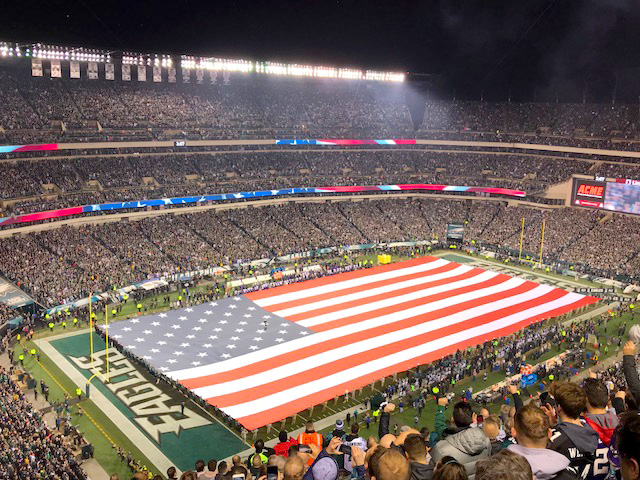
January 2018 — “Win it all and the party is on us,” read a Bud Light tweet to the Eagles back in August. With the Eagles securing their place in one of the biggest sporting events in the world, it’s not just free beer that’s on the line for the city of Philadelphia.

While it’s a known fact that the host city of a Super Bowl is going to experience massive (if inconsistent) economic gain from the event, the impact on the competing teams’ home cities is a little more nebulous. After all, there’s no obvious boost in things like hotel occupancy, flight bookings or ground transportation. The potential economic benefits for home cities are more of a long-term bump rather than a short-term windfall.

With all of the media attention and news coverage currently being piled on the Eagles, Philadelphia’s image as a destination city is sure to get a boost. This could lead to an increase in visitors down the road, especially in sports tourism (good news: Lincoln Financial Field offers both public and private tours). Team and related merchandise sales are on the rise (costume shops were scrambling to keep those rubber dog masks in supply even before the playoff game), and locals are feeling a renewed sense of pride in their city. As Eagles owner Jeffrey Lurie said, “You just want to win so badly for them.”

Psychic income — an economic term to describe non-monetary rewards — might not always come with big dollar signs, but it does bring real benefits. Emotional satisfaction is hard to measure, so if you’re the type that needs numbers, here’s something to consider: one study found that the real per capita personal income was higher in cities that have had a Super Bowl win, suggesting there’s a link between Super Bowl wins and worker productivity.

What we know for sure is that this is the first time the Eagles have been to a Super Bowl since 2004, and they’re the biggest underdogs to make the big game since 2009. Despite boasting one of the best defenses in the league, they have their work cut out for them in taking on the Patriots on February 4 at the U.S. Bank Stadium in Minneapolis.

While Boston cream donuts might not be getting any love from the City of Brotherly Love (one Philly shop banned their sale until after the Super Bowl), there’s no question that the underdog team from an underdog city is galvanizing its fans.

And if that’s not enough to get you excited, don’t forget that if the Eagles win, Bud Light has promised beer to the whole city!

Mixing Work and Play in an Innovative Way

April 2018 — Started in 1999 as a graduate thesis and initiated in 2008 with walking trails, the Atlanta BeltLine has come a long way from what it was once envisioned to be. The recent developments of office buildings, retail and residential space along and around the BeltLine have created an environment where residents have everything they need within walking distance. It is the ideal mix of work and play and continues to grow as a current real estate hotspot in Atlanta.

In fact, in December 2017, a $750 million mixed-use project was unveiled for the continued expansion of the BeltLine. The plans include two 12-story office buildings, one hotel, 700 residential units and 200,000 square feet of retail space. The BeltLine also hired a new CEO, Brian McGowan, to continue the project.

The Atlanta BeltLine Partnership was formed to raise philanthropic dollars to supplement the BeltLine’s efforts. The Opening the Corridor campaign, which began in 2017, helped fund the recent purchase of the Southside Trail as an interim connection. The $25.8 million project will connect the East and West sides of Atlanta for the first time in history.

Focus: Atlanta spoke with a number of city leaders in both the real estate and transportation sectors to get their insights on the mixed-use developments quickly sprouting up along the BeltLine. Here’s what they said:

Brian McGowan, CEO, Atlanta BeltLine

“The BeltLine is currently refocusing itself. We are 12 years into the project, and it is time to reflect on where we have come from and reevaluate the direction we are heading. The BeltLine is about people at the end of the day. Our focus is function over form.”  


Jim Irwin, President, New City Properties

“Offices along the BeltLine allow people to create more alignment between their work life and their personal priorities. Whether it’s commuting to work by bicycle or walking across the BeltLine to meet a friend for lunch at Ponce City Market, this project gives people an opportunity to work in a place that they truly enjoy.”

Chris Faussemagne, Principal, Westbridge Partners

“There are a lot of suburban submarkets that are creating their own central business districts. They are creating their own communities, jobs and places to live. That has been a great thing for the city because it relieves congestion. The BeltLine is also creating a lot of connectivity and alternatives to work and play.”

Matt Bronfman, CEO, Jamestown Properties

The BeltLine is like our beachfront property at this point. We need to make sure that the people developing on the BeltLine do things that are worthy in the long term. We need to get tougher on the development community to do interesting projects because that is how you get appreciation. The entire BeltLine will be completed sooner than people realize, and those neighborhoods will be made much better. Neighborhoods attracting young talent will be the most successful, and those are along the BeltLine.”

Scott Cannon, Executive Vice President, Skanska

“The Atlanta BeltLine Development is focused on getting people outdoors and being green. It’s about changing the way people live, work and play in the city. Skanska has a unique project that we are working on with architect Lord Aeck Sargent: the Atlanta BeltLine Urban Farm Shed. It is a 500-square-foot off-grid storage and work shed featuring a photovoltaic energy and storage system, composting toilet, and the use of salvaged and locally milled wood products.”

Greg Hare, Managing Partner, Ogletree Deakins

“Some of the critics of the Atlanta BeltLine have called it nothing but a glorified sidewalk. However, that big wide sidewalk creates better connectivity between neighborhoods, as well as tremendous economic development, because it’s a popular place to be. Developers are now putting a lot of money into parts of Atlanta that have not seen investment in decades.”

Chris Clark, President and CEO, Georgia Chamber

“We need to attract young professionals. We need to create the cool factor, which is why things like the BeltLine are important. We can offer great amenities and quality of life.”

To find out more about our interviewees above, visit their websites at:

Atlanta BeltLine: https://beltline.org
Westbridge Partners: http://www.westbridgepartners.net
New City Properties: http://www.newcity-properties.com
Skanska: https://www.skanska.com
Jamestown Properties: https://www.jamestownlp.com
Georgia Chamber: https://www.gachamber.com
Ogletree Deakins: https://ogletree.com