Invest: Miami speaks with Israel Velasco, Florida Region Executive
 One of our goals at Popular Community Bank is to maximize profitability while using fewer resources. To accomplish this goal, we are focusing intently on markets where we know we have the greatest competitive advantage. In 2014, Popular Community underwent a major restructuring, selling off its operations in California, Chicago and Orlando, leaving those in New York, South Florida and Puerto Rico. While we continue to function and present ourselves as a community bank, we have the benefit of a large, deep-pocketed parent company, Popular Inc. We access the extensive re- sources of our parent company to streamline and enhance our operations, particularly in the area of compliance. In this sense, we like to think of ourselves as a “super community bank.”
Looking forward, the sectors that will drive the growth of the local banking industry are those of commercial and industrial real estate, aviation and import/export. Following a “hub-and-spoke” model, our South Florida growth strategy will rely on the acquisition of branches, rather than opening new ones. Given today’s regulatory climate, it is difficult for new bank charters to be awarded. Along with growth in the sector, there will also be continued consolidation. More regional and so-called “big banks” will enter the market, and community banks will have a hard time remain- ing afloat, given the soaring costs of compliance.
Despite these challenging constraints, there will continue to be a place for community banks in this market. While larger banks have the advantage of more assets and technology, this does not mean they are necessarily more competitive when it comes to providing a high level of care and paying close attention to customer service. Despite the trends towards increased mobile banking and electronic transactions, at the end of the day, banking culture, especially in South Florida, is still very much “high touch”—that is, clients like to see and know who their banker is and we can provide that.
Invest: Miami speaks with Jorge Salas, President and CEO
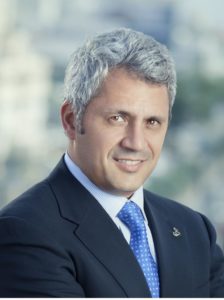 As Miami’s banking sector has grown significantly in recent years, it has become highly competitive. Competition is particularly strong for community banks; today, there are approximately half as many such banks in this market as there were 10 years ago, partially due to the cost of complying with new regulations. But this story is not the same for all banks.
Banesco USA, a community bank based in Coral Gables, is thriving. Why? Banesco USA is part of Banesco Financial Group, which has a presence in over 15 countries and manages over $100 billion in assets. It therefore offers the best of both worlds: the financial strength and expertise of a large corporation and superior personalized service.
Despite South Florida’s promising growth, the banking industry faces challenges, particularly in the real estate sector. The strengthening of the U.S. dollar is already affecting Miami’s condo market, given that at least 70 percent of sales are made to foreign nationals whose currencies devalued (against the U.S. dollar) in the latter half of 2015. Most of these countries are South American.
One of Miami’s greatest assets is its highly international character. This ensures diversification: when certain global markets are struggling, money will still flow into South Florida from other regions. Miami-Dade is seeing an influx of capital from New York and other northeastern U.S. cities, as well as Canada and many European countries, like Spain. (Such is the growth in Spanish investments that the affluent village of Key Biscayne has been nick- named Key Bis-Spain.)
A good example of this internationalization is the influx of Venezuelans fleeing economic and political instability. The impact of this migration is felt in the rapidly growing South Florida cities of West- on and Doral, which have high numbers of Venezuelan residents and businesses. The Venezuelans coming here are young, educated and driven to succeed. They greatly appreciate their new homes and are here for the long haul. In about 10 years’ time, they will be what many Cuban-Americans are today—Miami’s political and business leaders.
How the leading U.S. airport in air freight is crafting strategy for the long term
Emilio T. González Director – Miami-Dade Aviation Department
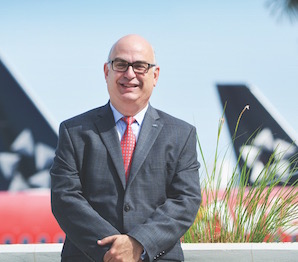
How has the strengthening U.S. dollar impacted passenger air traffic?
Our numbers have dipped as a result of the currency exchange rates, particularly when it comes to Latin American visitors. At the same time, we are expanding into new markets and seeing more diversification in our passenger lists. The net result was that 2015 was our best year for passenger growth, with 3 million more travelers year-over-year and a new record of 44.3 million annual passengers. Last year, Miami International Airport (MIA) also added eight new airlines and is now home to 101 carriers—the most of any U.S. airport. Additionally, MIA welcomed ve new international nonstop passenger routes: Cordoba, Argentina; Istanbul, Turkey; Manchester, England; Monterrey, Mexico; and Vienna, Austria. These developments speak to the fact that Miami is becoming more than just the Gateway to the Americas but the new gateway to the world.
For Miami-Dade’s business community, deepening ties with China is a top priority. What is MIA doing to facilitate direct air connection to the country?
Miami is the furthest geographic point from China in the mainland U.S., posing a significant barrier to bringing direct flights from China here. MIA’s strategy is not strictly focused on generating traffic to China, but building connectivity to Asia. Our studies show that mainland China on its own would not generate enough traffic to route a direct flight there, as they project that passengers from the country would only make up 25 percent of the demand for Miami-bound flights. However, Japan, South Korea, the Philippines, Indonesia, Vietnam and other Asian countries boast tremendous potential to fill planes. We are presently engaging with Asian air carriers that are investing significantly in ultra-long haul aircraft and looking to expand their routes, such as EVA Airways and Cathay Pacific.
In 2015, MIA was designated by the International Air Transit Association (IATA) as a pharmaceutical freight hub. What is the impact of this distinction?
Pharmaceutical air cargo is a huge industry, and so far we have only captured a small portion of it. In 2015, we became the first airport in the U.S.—and only the second in the world—to be IATA-certified as a pharma hub. In early 2016, MIA hosted our first, and well attended, workshop for key pharma stakeholders. This fits perfectly with our strategic plan to grow and diversify our cargo facilities. Pharma cargo at MIA has grown 80 percent in the last ve years. And with this designation, and the partnerships we’ve developed with our freight forwarders and customs brokers, I think we are well positioned to capture a huge portion of the lucrative global pharma business.
Invest: Miami speaks to Gary J. Spulak, President
In 2015, Embraer celebrated its 36th year in South Florida. Embraer’s arrival in Florida was our rst step toward globalization by establishing our U.S. presence. The U.S. was the most important aviation mar- ket at the time, and North America continues to be the strongest global market for Embraer aircraft. We arrived with a vision to become a major player in global aerospace and are now the highest aggregate value exporter in Brazil, a traditional commodities exporter.
For us, 2015 was filled with milestone achievements, notably a record sales order book value of $22.9 billion and the highest delivery volume of business and commercial aircraft in five years. Last year, Florida was key to the 10th anniversary of our executive jets business, launched in 2005 as a pillar of our diversification strategy. Since 2011, we have produced over 130 executive jets, valued at over $1 billion, in Florida. Most of these jets operate in the U.S., but we have also exported aircraft from Florida to 12 other countries. In 2013, we established a production facility for our defense and security business in Florida, and last year, it achieved its primary goal of delivering the first light-attack aircraft to the U.S. Air Force for Afghanistan.
To sustain global competitiveness, investment in innovation, research and development, new technologies and process enhancements.
Our corporate presence in South Florida is critical to our business development activities across the world. Over the last three decades we have witnessed Miami’s evolution from a hub of the Americas to a global platform for international business. As more businesses, industries and aviation companies recognize Miami’s key role in the global market, we will see more customers for commercial and business aircraft in our community.
Invest: Miami speaks with Marilyn Devoe, Vice President
 Two years ago, American Airlines merged with US Airways, becoming the largest airline in the world. Since then, our efforts have been centered on becoming the greatest airline in the world for our customers, employees, stakeholders and partners.
Miami International Airport (MIA) is our third-busiest hub, following Dallas/Fort Worth and Charlotte, and our largest hub for international flights. We continued to pursue growth in this vibrant city. Just last year, we added six new destinations from MIA: San Antonio, Austin, Kansas City, Salt Lake City, Barranquilla, Colombia and Monterrey, Mexico. But our growth is not just measured by the number of flights and destinations we serve; it is also seen in the number of widebody aircraft—that is, double-aisled planes—we operate at MIA. Each widebody added to our hub has a significant economic impact, contributing, on average, 16 new pilots and 45 flight attendants.
As the largest airline operating at MIA, accounting for roughly 70 percent of tra c and servicing a high volume of international passengers, it is more important than ever to ensure our processes are streamlined. Technology is playing a key role, from online check-in, to the free mobile passport app that allows U.S. and Canadian citizens to be granted clearance within four seconds of arriving at U.S. Customs. American’s crewmembers are provided with Global Entry, which further eases the e ect of our people on the Customs and Border Protection system. We are also working to create more exit lanes and recently began connecting international baggage, thus easing the ow for international customers arriving to or transiting through MIA.
MIA remains important to American’s present and is key to our future success. Apart from its strategic location, what makes Miami unique is the supportive, collaborative spirit of the government and the business community. In the past couple of decades, American Airlines and the Greater Miami area have both experienced incredible growth. And, looking ahead, we see a promising future for both.
Invest: Miami speaks to Michael Reininger, President
America’s love affair with the car grew from important societal developments. For baby boomers, the automobile represented access and social mobility. Getting a license meant freedom. Today, the car is increasingly becoming a hindrance to freedom.
What sets Brightline apart is that we are heavily invested not only in the idea of transit-oriented development but also in owning and operating a major component of the transportation resource as well. Almost everywhere else, the real estate component is the purview of the private sector entity, and transportation the purview of a public sector entity; we are invested in both. Individually, they represent robust businesses, but combined, one leverages the other, giving us a position nobody else has replicated. Our approach is decidedly private sector, different for example, from New York’s subway, which is necessarily public. This allows us to focus on profitability and serving clients, rather than maximizing ridership by keeping prices low at a profit loss.
South Florida is ideal for the Brightline train service. Historically, city development in Florida occurred along rail lines that have been maintained for the past 120 years, creating distances too long to drive comfortably and too short to y efficiently. We want riders to be able to tap into existing and emerging modes of transportation to increase accessibility throughout South Florida. When we started, services like Uber and city bike-share programs were not around, but since then, have grown immensely and we are finding ways to connect with these. Meanwhile, in developing our stations, we focus on variety, which means diverse uses of space—whether office, retail or entertainment. Looking ahead, multi-modal transportation development will continue to present more growth opportunities.
How transportation companies prepare for the future using the infrastructure of the past
Vincent Signorello, President & CEO – Florida East Coast Industries
What advantages does Florida East Coast Industries (FECI) hold when it comes to Florida’s infrastructure development?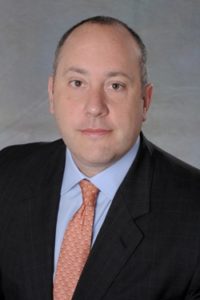
Established more than a century ago by American pioneer Henry Flagler, Florida East Coast Industries is the parent company of many leading real estate, transportation and infrastructure businesses. Our primary assets—namely Henry Flagler’s railroad infrastructure and prime land holdings—laid the foundation for our companies. We are continuing to leverage these unparalleled assets to either promote the businesses that have historically been built around them, or to build new businesses that help contribute to our overall goals.
The Florida East Coast Railway has long been an economic catalyst for the state, strategically moving both people and goods. When it comes to Miami’s logistics sector, what are the growth drivers?
Miami’s advantage in logistics is linked to the fact that its industrial complex is highly connected to Latin America. In fact, a significant amount of the warehousing in South Florida is occupied with many products that are ultimately destined for the region, whether that comes in through PortMiami or other South Florida ports. Miami’s unique position as a logistics hub helps companies like ours expand our industrial footprint. To do this, we are making smart investments in both Latin America and the Caribbean, and also leveraging the hub—that is, we are using Miami-based human resources, technology and ownership of assets to benefit the projects that we develop elsewhere.
FECI is also investing greatly in Florida infrastructure, specifically transit-oriented development. What trends do you see in that space?
The next generation of Floridians want to live, work and recreate near transit. We are actively addressing that demand by developing a network, some of which, like Brightline, is transportation infrastructure, and some of which is real estate infrastructure. From these projects, there are number of lessons. For one, we are financing and executing Brightline without any public funds. Because private entities are concerned with the time value of money and because private projects are less subject to bureaucratic processes that bog them down, such projects can be completed in a more timely and cost-effective manner. For another, our transit-oriented developments capitalize on existing assets, namely rail infrastructure, to build a pedestrian-friendly environment and connect residents and commuters with transit options.
How Miami-Dade’s public and private sectors are addressing the strain of rapid growth on the county’s underlying infrastructure
Jose R. Mas CEO – MasTec
How is Miami’s development boom affecting the county’s infrastructure?
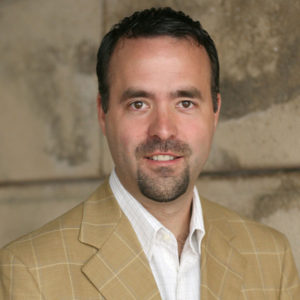 We are growing up as a city and to sustain this, we need to think about infrastructure. One issue that is not a priority, but should be, is our water and sewer systems. Our physical plant hasn’t been updated in decades and it is decaying fast. This is a hard political issue because we would have to spend money on it. We are also seeing limitations in terms of electricity. We don’t have the land to create big power-generation plants to support the pace of development. One option is to expand the existing power plants across the state, but this would mean putting in power lines, which is difficult because of environmental issues. Florida Power and Light (FPL) is trying to build a new transmission line from Turkey Point all the way to Downtown Miami and they are facing some community opposition. No one wants to see those big power lines on their street, but we have to find the right balance between aesthetics and meeting our growing needs. If something doesn’t happen soon, construction will have to slow down because electric utilities will not be able to meet the demands of those buildings. In terms of a viable renewable resource, there has been discussion about putting wind turbines in the Gulf Stream to generate hydroelectricity. Solar is another promising frontier for us.
How will the use of public-private partnerships (PPPs) address South Florida’s infrastructure needs?
PPPs are more efficient than wholly public sector-managed projects because private companies are more efficient when it comes to deploying capital. The major challenge comes about when public amenities turn into business ventures. Right now, we pay very low rates for water. But if Miami-Dade Water and Sewer Department (WASD) becomes a public-private venture, rates may go up. WASD is a significant monetary contributor for the county. What will happen if we take that source of income away from the county’s general budget? While there is a tradeo, we need to invest in our infrastructure for our long-term needs.
MasTec is also active in building telecommunications infrastructure. How will this evolve in Miami-Dade?
Technology is a big driver for our future, and we are going to see a massive expansion of gigabyte speed internet. Although we have a great telecommunications infrastructure, most of the facilities in Miami are still copper-based and it would take rebuilding the infrastructure to increase of the amount of fiber that is needed to give consumers higher speeds and much higher bandwidths.
Invest: Miami speaks to Joseph Kavana, CEO
When we purchased the land for Metropica over 20 years ago, we recognized development could move in two directions: north from Miami-Dade or west from Eastern Broward. Sunrise was an ideal location as it is at South Florida’s epicenter, close to four counties and four highways, including I-95 and the Turnpike. Despite proximity to these highways, we don’t have the traffic issues other areas have.
Sunrise’s enormous potential is no secret. Companies are migrating to the area, portending job growth. In 2014, American Express relocated its regional headquarters to Sunrise. The building is currently under construction and will bring over 6,000 jobs to the area. Organizations contributing to job growth and critical mass in West Broward include Cleveland Clinic, Nova Southeastern University, Florida Atlantic University, Broward College, HBO Latin America, the FBI Miami Field Office and the BB&T Center—all close to Metropica.
Setting Metropica apart from similar mixed-use projects is its design and the size of its land. The 65 acres have office, residential and retail areas, with the residential area in the center. Spanning 20 acres, a park and recreational areas surround eight luxury condominium towers. Residents will easily access amenities and enjoy unique dining, shopping and entertainment. Although these elements are close by, the project balances peaceful living and a lively downtown area to cater to buyers’ needs. Though Broward sees much business activity, people move here to find peace and harmony and avoid chaotic city life.
We are creating an oasis in a suburban setting. Moreover, as a transit-oriented development, Metropica promotes pedestrian life and bike use. Because we are located at the edge of the Everglades, it is important to minimize our environmental impact. Ultimately, not only are we creating a place to enjoy your days, but a place you will love to live in.
