July 2017 – With some of the most respected universities in the U.S., an abundance of well-paid IT jobs and an arts and leisure sector to rival any other major city, Atlanta is seeing a large influx of young professionals. With this changing demographic has brought new opportunities for the real estate sector. However, the image of classic white picket fence with a car in the driveway is disappearing as professionals want to be closer to their place of work, amenities and areas of social activity.
In January 2017, the City of Peachtree Corners, part of Gwinnett County in North Atlanta, saw the breaking ground of a 300-unit, 39-acre mixed-use 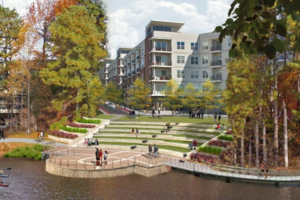 development. Once completed, the Overlook at Twin Lakes project, developed by Brand Properties, will feature modern retail, cyber cafes, a pool, a gym and dog park. Accommodation will be mainly 2-bed apartments. The main impetus behind the development is to house the young professional demographic, many of whom are attracted to the area because of the nearby Technology Park, a mixture of IT companies and coworking opportunities.
“The new trends in coworking environments mean that office development is mixed with hospitality and residential. Companies are using the new generation of offices as a way of attracting and retaining the best talent,” Kurt Hartman, senior managing director – Atlanta for Hines told Capital Analytics
The development is part of a growing trend across the U.S. that recognizes the differing requirements of young professionals, or “millennials”. In a poll conducted by National Association of Realtors and the Transportation Research and Education Center at Portland State University the 18-35 age group showed a strong preference to walking over driving as a method of transport. The gap of 12 percentage points of 71 percent for driving to 83 percent for walking suggests that environmental and health concerns are influencing the way people want to travel. With demographics in Atlanta shifting towards the 18-35 age range, these are facts that developers and agencies need to take into consideration.
“The corporate relocations have been a big deal for Atlanta. Young professionals are coming into the workplace and want to live in dense, urban communities,” Kirk Demetrops, principal of MidCity Real Estate Partners told Capital Analytics.
However, although an increase in employment opportunities drove a net increase of 10 percent for renters in the urban areas of Atlanta from 2010-2015, according to rentcafe.com, the high price points are still turning off the younger demographics. “Affordability is going to be a huge issue as we head into the future. If you look at Midtown, the apartments are reaching unprecedented highs. Millennials will not be able to keep up with $2,000 for rent. We want to focus on projects that have density and affordability,” Brent Story, president of Avalon Real Estate told Capital Analytics.
The same survey suggested an increase of 26 percent for the same time frame for suburban areas. In 2017, average rents for suburban vs urban saw a difference of around $200 per months with urban asking $1,277 and suburban, $1,006. This is a difference in line with areas such as Chicago and Los Angeles. All this points to the rise of the mixed-use development in an attempt to create urban feel and convenience in a suburban setting, with Alpharetta, Roswell and Tucker all becoming places of attraction.
With slower wage growth, the trend of starting a family later and an emphasis of flexibility means the 18-35 age group are leaving it longer than ever before to buy homes, creating investment opportunities for letting agencies and driving rent prices, although Atlanta still offers great value. “Atlanta is still considered to be affordable. New industries and increase in job growth will keep rents at the current price levels, but the increase in prices won’t be as fast as it was before,” Jeffrey Graham, managing partner of the Graham Group told Capital Analytics.
The Atlanta real estate market was one of the worst hit by the recession of 2008, with unemployment peaking over 10.5 percent in 2010, 0.8 points above the national rate of 9.7 percent. The growing demographic of young professionals points towards a decade of healthy recovery, and is one welcomed both by the real estate sector, as well as the Atlanta area as a whole.
“People in Atlanta are vested in making this a place of prosperity. This is evident by the growing number of graduates staying in Atlanta,” Monetha Cobb, managing director of Franklin Street told Capital Analytics.
With so much investment going into new-style developments, it seems likely that growth will continue.
Invest: Miami speaks with Juha and Johanna Mikkola, Co-Founders
There is a real renaissance taking place in Miami right now, but it faces challenges when it comes to workforce development. We are looking to address those needs by providing education, training and job placement in the technology sphere. The fact is, today, every company is a technology company. Every industry is a tech industry. By 2020 there is expected to be 1.4 million open computing jobs, for which there are only a projected 400,000 candidates. As a result, there is a growing demand for developers that isn’t being met by traditional education outlets.
Since it was launched in May 2014, Wyncode has graduated 138 students and maintained a job placement rate of 90 percent within three months of completing the program. Our model is unique in that we focus, not on theory, but on developing practical skills. We have experienced developers training new developers.
Following this success, we opened a new school in Fort Lauderdale in spring 2015. In 2015, we also became the first code school to be licensed by the Florida Department of Education. The issue of how to license code schools is a nationwide matter, and we are proud to be leading the nation in this matter. We have been invited to the White House twice to consult as part of the New Economy Skills Training Association (NESTA), an initiative of U.S. Chief Technology Officer Megan Smith.
Looking ahead, Miami will only continue to build o of its existing tech ecosystem. The biggest obstacle to this growth is the ability to acquire senior-level developers locally, but in time this will change. There continues to be a critical mass of local entrepreneurs who want to stay here, build here and seize on the opportunities offered by this dynamic market.
How Miami International Airport is expanding to better serve the city
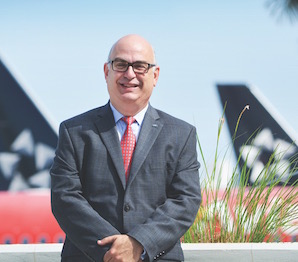
Emilio Gonzalez Director & CEO – Miami-Dade Aviation Department
 How will the increased investment in infrastructure lead to sustainable development of the economy?
Each daily international passenger fight at Miami International Airport (MIA) generates $33 million annually in business revenue, making international air service one of the biggest drivers of economic development locally and one of our community’s greatest assets. Our infrastructure improvements are focused squarely on international air service expansion. On the heels of successful north and south terminal redevelopment projects, the Miami-Dade Aviation Department (MDAD) is continuing to renovate MIA’s central terminal six of the Concourse E-Satellite’s nine gate areas and its second and third foor lobbies were upgraded and re-opened in 2016. MIA’s Terminal Optimization Program is a 10-year capital improvement plan for MIA’s Central Terminal, which began in 2015. Phase I of the TOP includes pre-construction work that began in 2016 to completely replace the baggage screening systems in MIA’s south and central terminals. The project, partially funded by a $101-million grant from the Transportation Security Administration, will double the systems’ current screening speed by installing the latest in Explosives Detection Screening (EDS) technology. MIA is also partnering with U.S. Customs and Border Protection to renovate and re-open the Concourse E international arrivals facility by the summer of 2017. In another innovative approach by MIA, the redesigned facility will be one of the frst in the country to screen passengers primarily via self-service technologies such as Global Entry, Automated Passport Control kiosks, and the Mobile Passport Control app.
What is your strategy to continue expanding into new markets for both passengers and cargo?
MIA is continuing its reinvention from being the Gateway of the Americas to a truly global gateway. Three of 2016’s new carriers are European-based, and two more European airlines have announced Miami launches in 2017. MDAD fortified its existing global business ties and established new ones in 2016 by investing in mission trips to strategic locations around the world. MDAD representatives traveled to Dublin, Ireland in June to participate in the International Air Transport Association (IATA) Annual General Meeting (AGM) and World Air Transport Summit, the world’s largest gathering of airline leaders. MIA was one of only a handful of airports in the world invited to attend the event, which drew more than 1,000 delegates. During the three-day gathering, I led an MIA team that met with high-level executives.
How PortMiami is growing to accommodate bigger vessels and larger volumes
Juan M. Kuryla Port Director & CEO – PortMiami
What were the major highlights for PortMiami in 2016?
If you look at our business model and our achievements in 2016, we had a very strong year for both cruise and cargo. It was the first time in 11 years that more than 1 million twenty-foot equivalent units (TEUs) have passed through the port two years in a row. That is a big accomplishment. We entered into our first private-public partnership with Royal Caribbean to build a large cruise terminal. It will be funded, operated and maintained by Royal Caribbean. We also received commitments from almost all cruise lines to renew their agreements and build upon their 2016 volumes at the port. We saw some steady cargo volumes in 2016. We are excited about 2017 in terms of seeing larger vessels come to the port of Miami because of the completed Deep Dredge and expanded Panama Canal projects. Panama deepened its canal, which allows larger ships to go through. Today PortMiami is the only port south of Virginia that can accommodate the largest ships that are laden and can go through the canal. We are already receiving larger ships transiting via the Canal.
What are the expectations for the cruise terminal? What are better ways the port can better its infrastructure?
One project that has been approved by the county commission is with Royal Caribbean. They are going to fund, construct, operate and maintain probably the largest terminal in the U.S. It will be able to berth the largest cruise vessels that exist today. That terminal and the commitments from Royal Caribbean, as a result of that construction, should take us from about 5 million cruise passengers to 6 million by the fiscal year 2018 to 2019.
With the completion of recent projects, such as the Panama Canal project, how has the cargo sector economically impacted Miami-Dade?
We are seeing an incredible investment that was put on the table by our elected leadership that allows us to invest in the port. We have received unanimous support from our mayor, our board and our governor, with a commitment of more than $100 million to fund the dredge and other projects. Recent figures say the port represents more than 207,000 jobs with an economic impact of around $28-billion impact. Those numbers were generated when we were doing about 20 percent less volume in cargo and 25 percent less for cruises. We anticipate our economic impact that we will be well above that.
What has the PortMiami’s 2035 Master Plan achieved so far?
In 2011, the board approved the 2035 Master Plan, and requested installation of additional cranes, which we have completed. They also mentioned the additional cruise ship berths, which we are building. We are beating the projections, particularly on the cruise side. By 2021, there’s going to be close to 7 million passengers per year. According to the plan, Miami was not supposed to experience that many until the late 2020s. This means we have to speed the project up.
How the Department of Transportation and Public Works is using information sharing to make a better transport system
Alice Bravo Director – Miami-Dade Department of Transportation and Public Works
 What are the most important milestones achieved by the Department of Transportation and Public Works in 2016?
When I started in this position, we were focused on the basics: clean, safe and reliable transportation. Along the way, we worked on the merger of the Miami-Dade Transit Department with the Public Works Department, which was formally approved in February 2016. We have been working with both sides to increase their synergies and leverage by pulling our resources together. In addition to paying more attention to cleaner trains, buses and other forms of transport, we have stepped up security by developing an app so people can report immediately if something happens to them. We will also soon launch new Metrorail cars, which use improved technology to run their systems and enhance reliability.
How has the investment in new technology helped to market transit services?
Investing in technology is one of our top priorities. Our buses have real-time tracking. We have revamped our app to make it more user-friendly and provide real-time tracking information. Recently, we debuted EASY Pay. This mobile ticketing system does two things. First, it eliminates the hurdle of dealing with a ticket vending machine. Second, it will help us provide incentives because we will be able to do cross-promotions with local businesses. With the data gathered, we know where our passengers get on and off. With this information we can, for example, offer coupons to use in the shops near the stops they use. With an account-based system, we can communicate better with our customers, enhancing information availability and thus encouraging people to increase their use of public transport. We believe that public transportation could work for a lot of people, but it has just never crossed their minds. Therefore, the first thing we need to do is to get them thinking about public transport. Second, we need to get them to use the app and trip planner to understand its ease and convenience. Lastly, we need to get people to realize that they can take Metrorail to the airport.
Which is being done to help promote awareness of the advantages of using public transportation?
We are combining better information with increased knowledge. A good example of this is the fact that we have uploaded information to our website about our corporate and student discounts. We also added other promotions, such as taking Metrorail to the airport. We know that many of our corporate clients will want to take advantage of these offers. For this, we teamed up with the Greater Miami and the Beaches Hotel Association, which has been actively promoting this option.
As the hub carrier for Miami International Airport (MIA), we produce just over 70 percent of the total volume in traffic and travel in and out of Miami. We understand our responsibility in delivering a world-class product that is reliable and safe. Our view of 2017 is to make sure that we improve our delivery of services and continue to find ways of improving the experience for our passengers. Miami is a unique hub – it is built to connect domestic and international traffic; it is the gateway to Latin America and the Caribbean; and it is a transit point from the Atlantic to South America. We are keenly focused on improving the connecting experience as well as our reliability. As MIA is the largest cargo hub in the U.S., we also want to produce a good product for our cargo customers. In 2016, we moved close to 50 million tons of cargo. We want to improve systems, platforms and tools to enable better delivery and weight management of our aircrafts. The biggest advantage of MIA has been Miami’s location, which has been a mutual benefit for both the county as well as American Airlines. We are the Southeastern most point of the U.S., centrally located within the Americas. From a distribution standpoint, Miami is incredibly well positioned. There is substantial local demand, which is well supported by connecting traffic. There will be a lot happening in 2017. We are focused on having the best network and schedule and want to enable the right timing, capacity and destinations. We are working on designing the next generation’s schedule. In 2017, We will have the third iteration of a Miami fight structure that we developed in 2014. We are looking at the directional plans of our fights, making sure they are optimized. We are looking at our feet, rationalizing and managing it optimally. At the same time, we are incredibly focused on ensuring that we build the schedule to capitalize on demand, but also operable and reliable. We have seen great improvements relative to the last decade, and we are expecting this trend to continue in 2017.
How can the universities better connect academia with industry to better facilitate praxis?
Generally speaking, all higher education has a desire to create a balance between theory and practice, or praxis. We know that is how students learn best. From my perspective, that is a good refection of who we are at Johnson & Wales University (JWU). This is why we have been implementing project-based learning for some time now. Of course, the perfect combination is always aspirational, but it is our goal and where we want to be. For this, we have been investing our efforts in training our faculty members to better balance both. For example, if a faculty member is specialized in research and theory, we will train him or her to also implement practical problem-solving, and vice versa. We train our professionals who are specialized in practical cases to also give theory the importance it deserves so students can maximize their learning opportunities. JWU creates partnerships with industry. Our curriculum is designed in concert with industry, which serves as a great benefit to our students, as well as industry leaders seeking to hire top talent.
What efforts is JWU making to ensure diversity at the institution?
Diversity is not the end-game. It all begins with diversity. I believe that diversity becomes the foundation of any institution. We have created a campus environment that respects diversity in a high level. But I believe that hiring is just as important. It is not enough to say that we can bring in students who are reflective of a diverse environment. We have to be able to introduce them to individuals who provide that same level of variety. We also integrate diversity into our programs. A good example of this is every year we collaborate with the Multicultural Foodservice and Hospitality Alliance. Recently, the Wall Street Journal published a ranking of diversity in the country and JWU came in No. 1 in South Florida and No. 3 in the nation. This is a reflection of our commitment to welcoming a diverse mix of students and faculty.
What incentives does North Miami offer to investors?
Through the North Miami Community Redevelopment Agency (NMCRA) we have a lot of incentive programs such as assistance 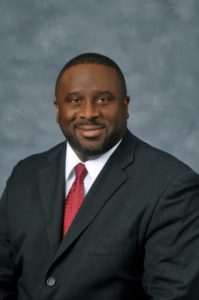 for acquisition, buildout and renovation grants. Through the NMCRA we are able to help pay the county impact fees for businesses in North Miami. These figures can be high for some of these businesses and we are able to help them. One of our new programs with the NMCRA is tax rebates. We do it through a tax increment finance agreement where, if you bring your business and create a number of jobs, we will give you a rebate of a portion of the property taxes generated by the business.
How are cities such as North Miami setting a good example when it comes to combating crime?
We have seen a reduction in our crime over the past several years. Our police department engages in the community and tries to be responsive to get ahead in areas where we see potential issues. We have added a number of resource officers into downtown and into the 7th Ave. corridor. These officers will be on Segways so that they are accessible to the community. Their presence creates an air of safety, and they have been successful in stopping crimes. This then creates awareness. Crime has not been a great issue in our city.
What is your vision for North Miami?
My vision is to help internally with the things people don’t see, such as improving our processes and making it easy to do business. We can provide incentives, attract businesses and provide basic services, but we also need to attract big projects. We are working diligently to invite the world into our city. We want to embrace the past and keep the charm of what was North Miami, with new developments and businesses. You have the opportunity to live, work and play in our city. We are open for business.
How the city of North Miami is attracting commercial interest to create positive growth
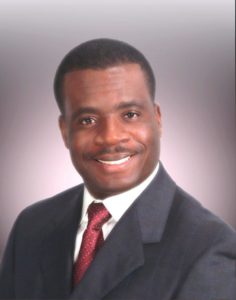
Smith Joseph Mayor – City of North Miami
 What are the most important aspects of the North Miami comprehensive plan?
To me, the single biggest opportunity from the plan is the height increase that we have implemented as part of our North Miami downtown development campaign. The new height restrictions should encourage more development projects downtown as well as bring more activity to the area. Another aspect of the plan is that we are the first city to take on the leading role in dealing with the threat of rising sea levels. Global warming is a major concern and, as a city government, it is important to take the appropriate steps to address these concerns. As part of community planning and development, we have policies in place for existing construction and programs to pinpoint buildings that may be at risk if we should have any incident of sea-level rise. My vision is to have a city that is resilient and able to withstand any adverse weather or climate change that will cause damages. I’m very proud of the fact that we took the leading role after Miami-Dade County.
What are the city’s current strategies to continue to attract and retain businesses?
Attracting new business or having them join this community is one our highest priorities. As mayor, I started a campaign to bring businesses and tackle unemployment in our city. Our unemployment rate was at 9.8 percent. First, I made sure that the North Miami Community Redevelopment Agency (NMCRA) was extended. The NMCRA is key in attracting investment into the area, and it will benefit many of the small businesses planning to come to North Miami, even offering partial subsidies. The Solē Mia Local Preference Office (LPO) managed by Garth Solutions will be very important in increasing community involvement, not only for residents but also small businesses. The LPO offers free job training and scholarship opportunities to North Miami residents in addition to offering essential consulting services to local firms. These local businesses are part of the fabric of our city, so it’s important to look after them. We have to make sure that they stay in the city and become part of the economic machine.
What would you identify as the biggest areas where new businesses or investors can get involved?
We have several main corridors. The main one is 125th street, heading east to west. West Dixie Highway is an area that I would really like to see developed. We need to attract more investment into these areas, because there is so much potential, but the city cannot development it alone. We are trying to encourage public-private partnerships.

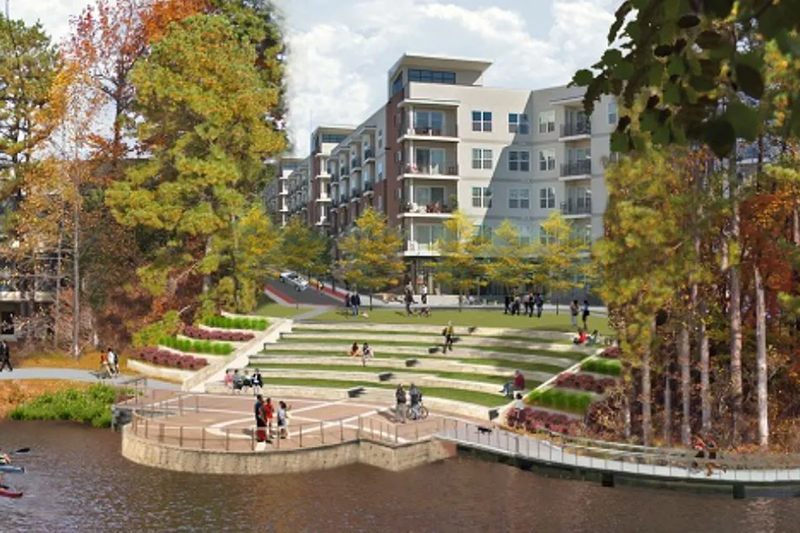 development. Once completed, the Overlook at Twin Lakes project, developed by Brand Properties, will feature modern retail, cyber cafes, a pool, a gym and dog park. Accommodation will be mainly 2-bed apartments. The main impetus behind the development is to house the young professional demographic, many of whom are attracted to the area because of the nearby Technology Park, a mixture of IT companies and coworking opportunities.