



Florida reopens: phase one of governor’s COVID-19 recovery plan in effect

Florida reopens: phase one of governor’s COVID-19 recovery plan in effect

By: Felipe Rivas

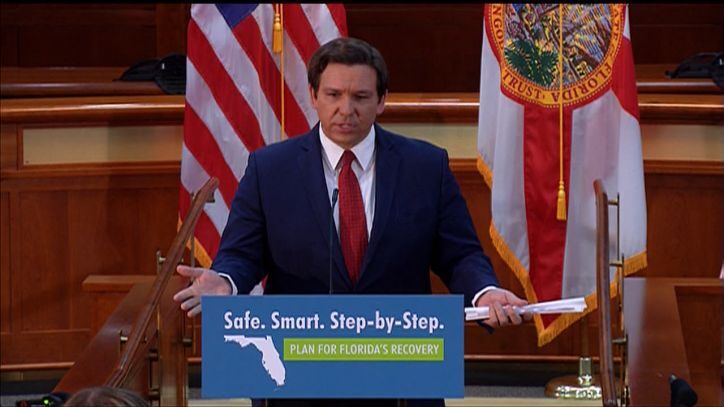
2 min read May 2020After weeks of shelter-in-place measures and business closures, the Sunshine State will begin the reopening process, as phase one of Gov. Ron Desantis’ recovery plan goes into effect. On Monday morning, as the governor’s stay-at-home order officially ended, the Safe. Smart. Step-by-Step. Plan for Florida’s Recovery plan began throughout the state. The plan allows certain businesses to reopen under specific restrictions and social distancing guidelines. The reopening plans do not yet apply to South Florida however, mainly Palm Beach, Broward and Miami-Dade counties, where most of the state’s confirmed COVID-19 cases are located. Shelter-in-place measures and business closures remain in place in those three counties. 


 Under phase one of the recovery efforts, restaurants may offer outdoor seating with six feet between tables and indoor seating at 25% capacity. Retailers may also operate at 25% of indoor capacity. Schools will remain with remote learning and all visits to senior living facilities are prohibited. Businesses such as bars, gyms and personal care services will remain closed as well, and it is unclear as to when they may open. 

Additionally, hospital systems can now resume elective surgeries, a major source of revenue for those facilities. Medical professionals throughout the state touted the recovery plan’s data-driven approach while prioritizing the health and wellness of Floridians. “Now, it’s time to reopen,” Tampa General Hospital President and CEO John Couris said in a press release.  “[Gov. Desantis] is taking a measured approach to reopening our state and getting people back to work while considering the health and wellness of those who are most vulnerable,” Couris said in a press release. In Orlando, Dr. Sunil Desai, president of Orlando Health Medical Group, echoed that sentiment. “Orlando Health fully supports Gov. DeSantis’ plan for incrementally reopening Florida,” Desai said in a press release. “Since early April, we have experienced a consistent downward trend in the number of cases of COVID-19 patients requiring hospitalization. Orlando Health has always remained committed to caring for the Central Florida community in a safe and compassionate way.”

For Miami-Dade, Broward and Palm Beach counties, three of the state’s most populous counties, a phased reopening of the economy may still be a few weeks away. For these counties, travel and tourism dollars, the service economy and international investment make up a substantial part of the local economy, all of which were disrupted by travel bans, shelter-in- place measures and shuttered business activity. However, though South Florida has been one of the hardest-hit areas by the COID-19 pandemic, the three county mayors believe their respective counties will be ready for a safe, efficient and phased reopening of their local economies.

“The past few months have been challenging, but Floridians have answered the call as they always do,” Palm Beach County Mayor David Kerner said in a press release. “Thanks to their efforts to help flatten the curve of COVID-19, we are well-positioned for the next steps to slowly reopen the state.” Broward County, in similar fashion, was projecting a severe impact from the pandemic, yet through swift action and close monitoring of cases, the county is preparing for the reopening of its economy. “While Broward County was projected to become one of the worst affected areas by this pandemic, we have been able to avoid this by using a data-driven and methodical approach to combating COVID-19,” Broward County Mayor Dale Holness said in a press release. “The leadership and residents of Broward County are united in this effort. Gov. DeSantis has been a strong partner in this fight and I look forward to continuing to work with him and leaders across the county and state as we strive to get things back to normal and emerge stronger than before.” Much like Palm Beach and Broward counties, Miami-Dade County also has felt the economic impact of more than six weeks of shelter-in-place measures, but county leaders continue to consult with local leaders and medical professionals and believe the county is ready for a phased reopening of its economy. “There’s no denying the negative economic impacts that COVID-19 has had on our county and our entire state,” Miami-Dade County Mayor Carlos Gimenez said. “However, thanks to the hard work of so many Floridians, we have made great progress in flattening the curve, and we continue to consult with health and medical experts to protect our residents. We are ready to begin reopening through a safe and thorough approach.”


To learn more about the  Safe. Smart. Step-by-Step. Plan for Florida’s Recovery, visit:

https://www.flgov.com/wp-content/uploads/covid19/Taskforce%20Report.pdf


Federal, state govts rally to help homeless during COVID-19 outbreak

Federal, state govts rally to help homeless during COVID-19 outbreak

By: Felipe Rivas

2 min read  — Since March, shelter-in-place measures have become the norm across the nation, shuttering nonessential businesses, schools and public gathering spaces. While the majority of people transitioned to a new way of life during the quarantine, including remote work and distance learning, the U.S homeless population risks COVID-19 infection as they lack access to testing and basic hygiene facilities, among other measures to combat infectious diseases. Additionally, for the homeless population, many are older adults or have underlying medical conditions, increasing the likelihood of contracting COVID-19. As such, states, municipalities, local health departments, housing authorities, among other institutions, have been working to meet the food, shelter, hygiene and testing needs of the homeless population.   


In South Florida, the Miami-Dade County Homeless Trust, in collaboration with various state and federal agencies, has been helping to protect sheltered and unsheltered homeless households and its staff in the face of the COVID-19 threat. “The Homeless Trust is proactive in engaging our housing and support service providers to offer guidance, assess needs and facilitate vital connections to local, state and federal resources,” said Trust Chairman Ronald L. Book in a press release. “Our preparations have to consider the fact that much of our population does not have a ‘home’ with which to self-quarantine; therefore, we have broader issues to consider. We will continue to work to ensure homeless households have access to shelter, care and food while doing all we can to mitigate the virus’ spread.”

As part of its outreach efforts, the Miami-Dade County Homeless Trust is distributing hygiene, safety and food kits to unsheltered homeless persons throughout the county along with educational information. Outreach teams are taking temperatures of unsheltered homeless persons to pre-identify those with symptoms, among other measures to help prevent the spread of COVID-19.

In Pinellas County, the city of Clearwater has taken similar steps to help the homeless population of the region. As part of its mission, the city’s economic development department is focused on economic growth and the vitality of the community, which includes the homeless population. As such, the department is encouraging restaurants that have had to close or limit their operations temporarily to donate food to food banks, which then distribute the food to the most vulnerable segments of the community, Economic Development and Housing Director Denise Sanderson told Invest: Insights in an interview. “We have not seen a big increase in street level homelessness,” she said. “We have seen an increase in the presence of our homeless community. Primarily because we have had to close down our recreation centers and libraries.” As those facilities closed, the department pivoted to placing porta-potties and mobile shower units throughout the city to help the homeless community stay clean during this time. “To date, we have not had any cases, at least known to us, where COVID-19 has affected the homeless population.” Sanderson said. 

In Orlando, the shelters are preparing for an influx of homeless people. Shelters are down beds because social distancing precautions require separation of beds, Spectrum News reported. Shelters are concerned with bringing in people who may have the virus. “Right now we have a campus that is fairly safe. How do we bring people on without introducing that,” John Hearn, president and CEO of the Coalition for the Homeless of Central Florida, told the news outlet. Hearn’s shelter has been screening everyone before they enter the campus. The shelter set up isolation areas for people showing symptoms. This move, along with social distancing measures, cost the shelter close to 50 beds, Spectrum News reported. His shelter has increased the distribution of meals to three times a day and still has open beds available, according to the news outlet. 

At the federal level, the Coronavirus Aid, Relief, and Economic Security (CARES) Act, a $2 trillion funding package aimed at protecting the population, industries and businesses from the impact of the coronavirus, set aside more than $12 billion to help the homeless population and those who serve them. Community Solutions, a nonprofit organization focused on ending homelessness, detailed the portion of the CARES act aimed at helping those experiencing homelessness. The Department of Housing and Urban Development would divvy up the funds for Emergency Solutions Grants to assist homeless shelters and outreach workers who keep people who are homeless safer from coronavirus, different rent assistance programs, and other assistance programs aimed at the elderly, Native Americans, and people with AIDS, among other initiatives, according to Community Solutions. Federal, state and local agencies must work together to optimize resources and help for the homeless population, the nonprofit wrote on its website. “While we are pleased that our federal lawmakers provided this needed fiscal relief, we need to ensure that people experiencing homelessness, and those who serve them, continue to be supported as state and local governments work to administer funds and in any forthcoming stimulus package, Community Solutions said. “Following the injection of this stimulus funding, state and local governments must focus on allocating this new funding to protect people experiencing homelessness and homeless response staff, and limit inflow into health care and hospital systems. This includes ensuring people experiencing homelessness — and the people helping them — have immediate access to housing, health and safety training, personal protective equipment, facilities for hand-washing, medical treatment, testing options and ultimately, safe places to quarantine.”


To learn more about our interviewees, visit:

https://www.centralfloridahomeless.org/

http://www.homelesstrust.org/

https://www.myclearwater.com/government/city-departments/economic-development-housing

https://community.solutions/covid-19-and-homelessness/

COVID-19 making innovation a must for educators

COVID-19 making innovation a must for educators

By: Felipe Rivas

2 min read April 2020As the coronavirus reduced daily activity to only essential services, educational institutions were forced to transition at a moment’s notice into a virtual setting as shelter-in-place measures and social distancing became commonplace. Entire curriculums, testing, labs, and even physical education in some cases, transitioned into an online classroom setting as teachers and students of all grade levels resumed their education under the COVID-19 pandemic. 

These risk-management decisions stressed and challenged the infrastructure of universities, colleges, and schools throughout the nation, while at the same time creating opportunities for innovation in the educational landscape. Although fully online classes are a temporary measure to slow the spread of COVID-19, and as local, state and national governments consider what a reopened economy may look like, educational systems alike are being forced to mitigate the challenges and innovate their educational practices and offerings via learning innovation and digitalization.

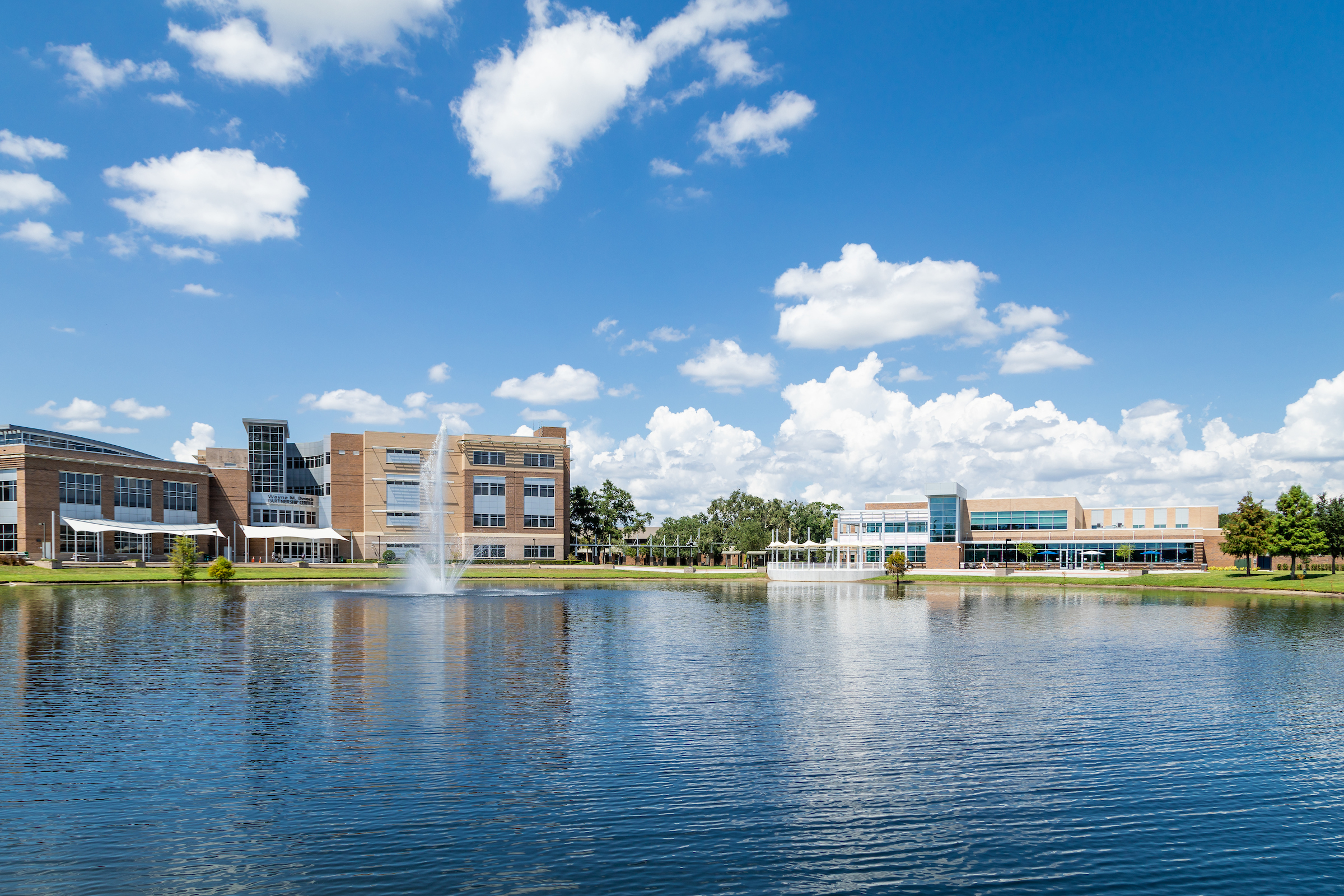
In Orlando, Seminole State College of Florida was able to make the transition into a fully online learning setting effectively because its student body and faculty were already familiar with online and remote learning. Prior to the COVID-19 outbreak and shelter in place measures, the college was well-positioned for the quick change of events, President Georgia Lorenz told Invest: Insights in a virtual interview. “About 53 percent of our students were already taking at least one online course as part of their schedule. The vast majority of our students at some point of their academic career have had familiarity with our online learning managing system,” she said. Many of the campus based classes use the same learning management system to enhance and support the learning process, making the transition easier to handle for faculty and students. Additionally, the college also quickly transitioned its library, student support systems, and other resources online to maximize the learning experience during a time of abrupt changes. “It’s been a lot of work and I give a lot of credit to our faculty, students and all of our staff for making this change very quickly.” 

In the COVID-19 landscape, tuition-dependent institutions are among the most vulnerable as students are liable to put their education plans on pause as they grapple with loss of employment and income. Colleges and universities with strong endowments and alumni contributions will likely survive the impact of COVID-19, but declines in revenue and increases in costs will likely loom for the coming academic years. Declining revenues could stifle innovation as institutions reprioritize budgets and offerings. 

However, a life post-COVID-19 may be ripe with opportunities for innovation and further streamlining of classes. COVID-19 helped destigmatize fully online learning. Moving forward, educational leaders will likely see online education as more than a source for extra revenues. Instead, online education will likely become an integral part of institutional resilience and academic continuity. Educational institutions will have to rethink how they plan for, fund, and market online learning. More unified institutions will emerge from the coronavirus pandemic, as online courses and student support functions become more centralized and integrated into existing academic structures and processes. 

At Seminole State College of Florida,  “students are appreciating the e-services and online learning capabilities,” Lorenz said. “We are continuing to innovate and fine-tune as we move forward, but it seems to be working really well for a good portion of our students and staff.”

In terms of lasting innovation, it is possible that online learning goes truly global as colleges and universities expand their student base to allow for more international students who may never see the inside of a physical campus. 

The lasting impact of COVID-19 to the educational sector remains to be seen. For the time being, it is likely that students will finish the spring semester and potentially the 2019-2020 school year from the comfort of their homes. As educators prepare for summer and fall semesters, they will have to contend with the challenges and opportunities of educating students in a post-COVID-19 world.       

To learn more about our interviewee, visit: https://www.seminolestate.edu

To view the interview with Seminole State College of Florida President Georgia Lorenz, visit: https://www.youtube.com/watch?time_continue=6&v=MhowKRH4dkY&feature=emb_title

https://live.capitalanalyticsassociates.com/invest-insights/

Spotlight On: Dixieanne James, President & COO, Einstein Medical Center Philadelphia, Einstein Medical Center Elkins Park, MossRehab, Willowcrest, Einstein Center One

Spotlight On: Dixieanne James, President & COO, Einstein Medical Center Philadelphia, Einstein Medical Center Elkins Park, MossRehab, Willowcrest, Einstein Center One

Invest: Insights

Claro Development has a clear picture of the Charlotte market

By: Felipe Rivas2 min read October 2020 — While the national real estate and development sector continues to adjust to the ever-changing pandemic landscape, this period is also a time to strategize and think about future opportunities and expansions. To that end,...

Innovation and adaptation: What this could mean for education post-pandemic

By: Beatrice Silva2 min read September 2020 — The pandemic forced educational institutions to pivot all of their operations to a completely virtual landscape. Many university leaders were planning on returning to normalcy at some point in the upcoming months, but that...

Capital Analytics Highlights Charlotte’s Business Growth

By: Felipe RivasCapital Analytics Highlights Charlotte’s Business Growth Invest: Charlotte offers economic insight in a time of uncertainty July 13, 2020 FOR IMMEDIATE RELEASECHARLOTTE, NC — Capital Analytics’ in-depth research into the Charlotte market is an...
Tampa Bay is once again home to the Stanley Cup

Tampa Bay is once again home to the Stanley Cup

By: Max Crampton-Thomas2 min read October 2020 —It’s been 16 long years but the Stanley Cup has made its way back to Tampa Bay. After a six-game battle with the Dallas Stars, the Tampa Bay Lightning were able to close out the NHL finals series with a dominant 2-0...
Atlanta’s public schools eye phased return to the classroom

Atlanta’s public schools eye phased return to the classroom

By: Felipe Rivas 2 min read September 2020 — With Atlanta’s transition into Phase II of the City's Five Phase Reopening Plan earlier this month, the Atlanta Public Schools system now looks to follow suit with its return to face-to-face instruction. Superintendent Lisa...

His Airness bullish on NASCAR

His Airness bullish on NASCAR

By: Felipe Rivas2 min read September 2020 — After conquering every imaginable feat on the basketball court, His Airness is ready to let it fly on the asphalt. Charlotte Hornets owner Michael Jordan, together with NASCAR driver Denny Hamlin, will own the newest car...

The Fort Lauderdale International Boat Show must go on

The Fort Lauderdale International Boat Show must go on

By: Beatrice Silva2 min read September 2020  — The Fort Lauderdale International Boat Show (FLIBS) must go on despite challenges surrounding COVID-19. For decades, the Marine Industries Association of South Florida has hosted the annual event, which showcases boat...

Palm Beach County’s unemployment rate back to single digits

Palm Beach County’s unemployment rate back to single digits

By: Felipe Rivas2 min read September 2020 — Recovery efforts in Palm Beach County are trending in the right direction toward Q4. Palm Beach County’s unemployment rate is back to single digits, according to newly released data. The county’s jobless rate fell from 11.5%...

Invest: Publications

Comprehensive investment information on the markets we cover to promote the market as a destination for business and investment

Invest: Orlando

Nulla porttitor accumsan tincidunt. Praesent sapien massa, convallis a pellentesque nec, egestas non nisi. Curabitur

Networking

Say Cheese

Nulla porttitor accumsan tincidunt. Praesent sapien massa, convallis a pellentesque nec, egestas non nisi. Curabitur

Starting a Business

DiviBuilder

Nulla porttitor accumsan tincidunt. Praesent sapien massa, convallis a pellentesque nec, egestas non nisi. Curabitur

Contact

Email

contact@capitalaa.com

Address

2800 Biscayne Blvd, Miami, Florida, 33137

Understanding and addressing the current reality

Understanding and addressing the current reality

By: Max Crampton- Thomas

The Tampa Bay region, like everywhere else, is feeling the deep impact from the COVID-19 pandemic. In an interview with Invest:, Tampa Bay Beaches Chamber of Commerce CEO Robin Miller reflects on the economic fallout from the pandemic, how the chamber is supporting local businesses and what role the community can play to help businesses through this unprecedented crisis.


What have you already seen in terms of economic impact from the COVID-19 pandemic on the business community in the Tampa Bay region?


There has been unprecedented impact in nearly every sector; however, hospitality is at the top of those extremely impacted. When you look at this from the loss of jobs to the closure of hotels, this trickle effect impacts sales tax generated as well. For many years, we would have communities and people complain about visitors and tourists here. Now, the unfortunate reality is that this is what it looks like when we don’t have tourism in our communities.

How is your organization working to assist the business community in mitigating the challenges and impact felt from the COVID-19 pandemic?


We are working extremely hard to provide clear and concise information; assisting businesses in navigating and understanding the stimulus; and lastly, but more importantly, we have created a partnership with Feeding Tampa Bay and are providing food pantries once a week and access to produce.

Do you feel the business community is receiving enough state and federal support?


I think it is a good start; however, we are advocating strongly for sector-driven financial support that are not loans. The anxiety and stress of no business at all and keeping people employed is debilitating, and then the pure thought they will need to take out loans is overwhelming. This is a line item in a businesses budget that was not planned. They need access to grants and more of it. I think local governments can play a key role in this as well.


How can the community best assist the local businesses in this time of need?


Be patient with businesses as they now have a new normal to exist in. Once we start staggering the openings of our local communities and businesses, we all need to create a new plan to support them. We will all be on limited funds for months to come. I suggest that whenever we need something, let’s not immediately open an Amazon web window. Let’s instill a behavior that we immediately access our local options first. If you think you can get it on Amazon cheaper, tell your local business that. We need to band together in this support now more than ever.

For more information on our interviewee, visit: 

https://www.tampabaybeaches.com/

Staying connected: Hosting digital events during the coronavirus

Staying connected: Hosting digital events during the coronavirus

By: Felipe Rivas

2 min read April 2020 — The novel coronavirus forced a global halt to major international, regional and local events. From the NBA season to networking conferences, all gatherings of any size stopped abruptly in an effort to flatten the curve and prevent COVID-19, the disease caused by the coronavirus, from spreading further. However, as the population at large becomes accustomed to social distancing, stay at home orders and self quarantining, many events went from a hard stop to full speed ahead virtually. As the business community adjusts to the challenges of the disruption caused by the coronavirus, many institutions are building value and maintaining relationships with patrons by maximizing the use of webinars, online classes, video conferences and even virtual happy hours. 

Throughout the nation, residents, institutions, and businesses alike have been forced to adapt to social distancing. Virtually every educational institution has gone fully online in an effort to keep staff and students safe during the coronavirus pandemic. On the business front, major companies have pivoted to fully digital events for participants to enjoy. For example, technology giant, Google, recently decided to move its entire Google Cloud Next ’20: Digital event online. The event will be a free, global, digital-first, multiday event aiming to connect attendees to streamed keynotes, breakout and interactive learning sessions, among other activities. During the coronavirus, these types of initiatives will become the new normal until it becomes safe to resume traveling and large gatherings.

The video conference platform, Zoom, has quickly become ubiquitous across the virtual events space. Across economic sectors, different institutions are taking advantage of Zoom and similar platforms. To host a successful virtual event, event planners must decide between hosting a virtual meeting or a webinar. “If you expect attendees to mostly just listen,” the best option is a webinar, Zoom advises as part of its digital event best practices. “When you need more back and forth between the audience and the host,” planners should choose a virtual meeting, the platform advises. 

Once the type of digital event has been narrowed down, hosts should hardwire the internet connection to prevent any Wi-Fi-related hiccups or virtual lag. In terms of audio, hosts should test speakers and audio prior to the meeting and minimize any background noise, according to Zoom. Additionally, hosts should dress to impress and make sure to start the virtual event on time. It is important to set the tone of the event and encourage Q&A’s during the virtual meeting or webinar. As a best practice, Zoom recommends the use of the Chat function to keep track of questions and comments. For larger webinars, Zoom offers a PayPal integration to charge the registration fees seamlessly. 

For the time being, social distancing will be part of the mainstream business landscape until at least May. However, many institutions are adjusting and pivoting more and more to the virtual hosting model to build value, share information and regain a sense of community in a time where residents are being asked to self-isolate as much as possible.  

To learn more visit: https://blog.zoom.us/wordpress/2020/03/04/best-practices-for-hosting-a-digital-event/

https://cloud.google.com/blog/topics/google-cloud-next/join-us-for-google-cloud-next20-digital-connect


Staying connected: ‘Saturday Soiree’ in Palm Beach

Staying connected: ‘Saturday Soiree’ in Palm Beach

By: Felipe Rivas

2 min read April 2020 — The novel coronavirus forced a global halt to major international, regional and local events. From the NBA season to networking conferences, all gatherings of any size stopped abruptly in an effort to flatten the curve and prevent COVID-19, the disease caused by the coronavirus, from spreading further. However, as the population at large becomes accustomed to social distancing, stay at home orders and self quarantining, many events went from a hard stop to full speed ahead virtually. As the business community adjusts to the challenges of the disruption caused by the coronavirus, many institutions are building value and maintaining relationships with patrons by maximizing the use of webinars, online classes, video conferences and even virtual happy hours. 

In its “Staying Connected” series, Invest: is talking to leaders in various markets about their efforts to, well … stay connected.

In Palm Beach, a region known for its daily community outdoor events and weekend parties,  institutions have had to shift to online platforms to preserve the community feel and give people an escape from social distancing. The West Palm Beach Downtown Development Authority did just that by hosting a party with musicians online. “This past saturday, we hosted what was to have been an outdoor event called ‘the Saturday Soiree’ with musicians and we streamed it throughout social media and let each one of them have their set,” Executive Director Raphael Clemente told Invest: Palm Beach. “It was a big success and gave us ideas on how to keep Downtown top of mind,” he said. 

The authority is focusing on being a support system for residents and Downtown business leaders in this period of economic uncertainty. “We meet with a lot of stakeholders, and internally. I am loving Skype and Zoom. We have gone to these platforms as everyone else has. As a team, a big part of our conversation was how we can do our job of marketing and sharing information, but keeping top of mind the sensitivity of people right now to their business issues,” Clemente said. “It is not just what we are saying, but how we are saying it. Also, just picking up the phone, versus using only email, is an important thing to do.”

The video conference platform, Zoom, has quickly become ubiquitous across the virtual events space. Across economic sectors, different institutions are taking advantage of Zoom and similar platforms. To host a successful virtual event, event planners must decide between hosting a virtual meeting or a webinar. “If you expect attendees to mostly just listen,” the best option is a webinar, Zoom advises as part of its digital event best practices. “When you need more back and forth between the audience and the host,” planners should choose a virtual meeting, the platform advises. 

Once the type of digital event has been narrowed down, hosts should hardwire the internet connection to prevent any Wi-Fi-related hiccups or virtual lag. In terms of audio, hosts should test speakers and audio prior to the meeting and minimize any background noise, according to Zoom. Additionally, hosts should dress to impress and make sure to start the virtual event on time. It is important to set the tone of the event and encourage Q&A’s during the virtual meeting or webinar. As a best practice, Zoom recommends the use of the Chat function to keep track of questions and comments. For larger webinars, Zoom offers a PayPal integration to charge the registration fees seamlessly. 

For the time being, social distancing will be part of the mainstream business landscape until at least May. However, many institutions are adjusting and pivoting more and more to the virtual hosting model to build value, share information and regain a sense of community in a time where residents are being asked to self-isolate as much as possible.  

To learn more visit: https://blog.zoom.us/wordpress/2020/03/04/best-practices-for-hosting-a-digital-event/

https://downtownwpb.com/

Spotlight On: Kevin Poet, Charlotte Vice President of Operations, Siemens

Spotlight On: Kevin Poet, Charlotte Vice President of Operations, Siemens

By: Felipe Rivas

2 min read AprilCompanies across sectors are fervently working to reduce emissions, switch to renewable energies and use technology to create a cleaner, greener future for the next generations. The same is true for companies directly involved in the energy industry. This year, Siemens AG. announced it will create a new company, Siemens Energy, focusing on conventional power, oil and gas, power transmission and renewable energy to position itself for the future of the industry. In an interview with Invest: Charlotte, Vice President of Operations Kevin Poet talks about the decision to create the new power and gas company, some of the challenges and opportunities in the energy industry and the near-term outlook for the industry. One of the challenges is balance, as it relates to balancing the needs and the drive to go as fast as we can to clean energy, with the need to continue to supply the demand today with the technology available

 What will be the focus of Siemens Energy?

The operations in Charlotte and Winston-Salem will be part of the new company. The largest manufacturing site in North America is in Charlotte and gives us the opportunity to focus on growing the business in new areas and markets that we have not traditionally been in. Our legacy work at the Charlotte plant is primarily large-scale, fossil-power generating equipment, and that market and demand is going down, mainly due to renewables and energy efficiency, as well as the push for decentralization and new technologies. We believe this trend will continue, and for us to thrive in a new market we have to get into different businesses and expand our portfolio. In the short term, we are looking at smaller, industrial-sized units that companies use to decentralize their power needs. In the future, we will see these units move toward hydrogen-burning technology, and potentially into new businesses altogether in the mobility, or renewables and wind areas. As a manufacturing center, we have the installed capability necessary to manufacture any of the components, products, and systems along the whole value stream. Our growth initiative aims to reshape what the future looks like as far as engineering and manufacturing.


What will the future of clean energy look like?

One of the challenges is balance, as it relates to balancing the needs and the drive to go as fast as we can to clean energy, with the need to continue to supply the demand today with the technology available today. For Siemens, we are the only site in North America that can service the large, traditional generating units that are in power plants. It will be critical for our business going forward, and for our customers, to continue to supply components and provide service for those units until they are transitioned into a cleaner form of energy, or retired altogether. Investment in the energy business is a huge challenge because of the size and scope, the length of the investment and payback. Typically, investing in a power plant is a 20- to 30-year investment. The changing landscape around technology, and what the future of energy will look like, and the volatility when it comes to policy, has a lot of people nervous about making large investments. There is a tug of war between the need to invest and innovate and concern with what the future could look like.   


How can companies take advantage of the talent based in the Charlotte region?

The Charlotte region has a developed ecosystem around providing talent. The university system in the region is superb. There is an abundance of opportunities for university partnerships in research, development and workforce training. For example, we do our apprenticeship program through Central Piedmont Community College. They helped develop the curriculum and advised on the training courses, length of time and certifications. They really helped put together a good structured approach to the needs we were trying to fill, and this is happening with other universities across the region as well. For companies looking to relocate to the region, those kinds of available relationships are a selling point.


To learn more about our interviewee, visit: https://new.siemens.com/us/en/company/siemens-in-the-usa/charlotte.html


GFL Businesses Adapt as Coronavirus Threat Looms for US

GFL Businesses Adapt as Coronavirus Threat Looms for US

By: Sara Warden

2 min read March 2020 — Businesses across South Florida have been hit by the impact of the Coronavirus pandemic, as the government issued new advice urging people to stay home if possible. Drastic measures have been taken to prevent the further spread of the virus, but some Fort Lauderdale companies are taking the crisis in stride.


Fort Lauderdale made the decision to close all public beaches, bars, nightclubs and restaurants. All meetings of city boards and committees have been postponed until the end of March at the earliest. Only essential businesses such as pharmacies and grocery stores are excluded from the measures. The TSA reported that one of its agents at the Fort Lauderdale-Hollywood Airport tested positive for the virus, bringing the tally to two officers across the state.

“We have to do everything possible to minimize crowds and unfortunately, our beautiful beaches must be part of that plan,” said Fort Lauderdale Mayor Dean Trantalis to South Florida Business Journal. “I want to be clear that this is not an overreaction, but a way for us to help stop further cases of COVID-19 in our community.”

With the measures set to last until April 12, one of the biggest concerns for Fort Lauderdale residents – and for people all over the world – is of a potential shortage in supplies of essentials such as canned goods, medicine and toilet paper. 

As the virus response ramped up, Postmates and Walgreens announced an expansion of their partnership to allow customers to order Walgreens pharmacy goods through Postmates and have them delivered to their doors. The service was piloted in New York six months ago but its ramp up to cover a handful of cities including Fort Lauderdale comes at an opportune time to allow citizens to comfortably practice social distancing. 

Businesses are urging employees to work from home, but are threatened by a drop in productivity. Some forward-thinking businesses had already made preparations, having monitored the unfolding situation from its roots in China’s Wuhan region in December. Davie-based Bankers Healthcare Group implemented home office last Friday after extensive testing of its digital systems. 

“We’ve been preparing for this transition for more than a month, checking and testing our systems to ensure we could continue to do business as usual,” co-founder Eric Castro told South Florida business Journal. “We don’t anticipate any challenges or disruption to our business, and are confident we will not lose productivity.”


To learn more, visit:

https://www.broward.org/Airport/Pages/default.aspx

https://postmates.com/

https://www.walgreens.com/

https://bankershealthcaregroup.com/


For up-to-date advice on the Coronavirus response, you can check the CDC website here.  For Florida-specific information, click here