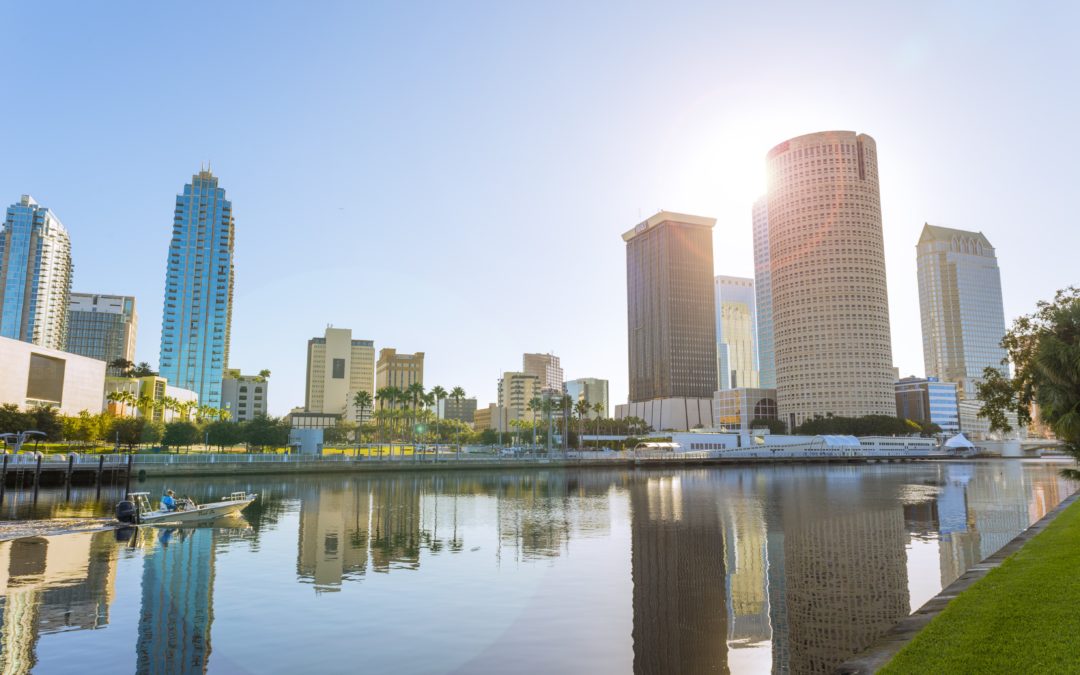
Commercial Real Estate to Remain Steady in 2020

Commercial Real Estate to Remain Steady in 2020

By: Max Crampton-Thomas

2 min read February 2020 If there were ever a time or place to consider investing in commercial real estate, now would be that time and the Tampa Bay region would be that place. 2019 proved to be another banner year for the real estate sector and with interest rates remaining low, consistent inmigration into Florida and the Tampa Bay region, rising rental rates and ongoing outside investment into the area, all indicators point to 2020 being just as strong if not better for the commercial real estate sector. 


2 min read February 2020 If there were ever a time or place to consider investing in commercial real estate, now would be that time and the Tampa Bay region would be that place. 2019 proved to be another banner year for the real estate sector and with interest rates remaining low, consistent inmigration into Florida and the Tampa Bay region, rising rental rates and ongoing outside investment into the area, all indicators point to 2020 being just as strong if not better for the commercial real estate sector. 

“Around $17 billion has migrated to Florida, the No. 1 destination for capital in the country followed by Texas, at $2 billion. People are leaving states that are not tax friendly and coming to Florida, which is very tax friendly. Because the stock market can go up or down, hard assets are attractive. The returns investors can get in commercial real estate are attractive. People are looking at commercial real estate as a means for retirement, passive income,” Christopher Travis, sales manager for the Tampa office of Marcus & Millichap, remarked to Invest:.  

Perhaps the clearest indication of the sector’s continued success has been the large-scale mixed-use projects that are happening throughout the region. Larry Richey, the managing principal and Florida market leader for Cushman & Wakefield, spoke about what these developments mean for the sector. 

“The most talked about projects happening in Tampa Bay at the moment are in the office and mixed-use sectors. In the Hillsborough County market, we have four mixed-use projects that are all very active. Those four new projects are Water Street Tampa in Downtown, Heights Union just on the northern fringe of Downtown, the Midtown project that is being developed at the intersection of I-275 and Dale Mabry and fourth is the MetWest project in the Westshore District on Boy Scout Boulevard,” Richey told Invest:. “We are seeing the highest office rents in the history of the Tampa Bay area right now, and it is because we have the strongest demand for office space that we have ever had. This is good news because it means new development and jobs in the commercial real estate sector. It also means that buildings that were always below what they should have been charging are now charging rents that are justifiable based on the investment that people have put into these properties.” 

These projects, and ultimately the continued success of commercial real estate in Tampa Bay, are the product of taking note and early adaptation to emerging and developing trends within the industry and local economy. While basically all subsectors of commercial real estate are prospering, there are some that industry professionals are keen to keep a particularly close eye on. What may come as a surprise to some is that one of these prosperous submarkets is retail. 

“The retail market continues to be very strong here.  Demand continues to exceed supply in many of the strongest retail markets throughout Tampa Bay.  This continues to drive up rental rates and has limited cap rate decompression for stabilized retail assets,” Scott Dobbins, the founder and principal of Hybridge Commercial Real Estate, said. 

Travis agreed that retail remains one of the stronger segments in commercial real estate, touching on the fact that the e-commerce trend is not as bad as some may think. “Retail has remained strong during the real estate market recovery. Everybody was scared about e-commerce, but it only makes up about 14% of the overall market. Retail is going to be just fine, especially retailers like dollar stores, gas stations, and fast food.” 

While all indications point to another strong year for the commercial real estate market, it will not be without its challenges. Besides 2020 being an election year that could possibly send the national economy into flux, Tampa Bay must address unaffordability in the housing sector and ongoing challenges with transportation in the region. 

Nonetheless, commercial real estate professionals continue to have a positive outlook for the Tampa Bay Region. 

It has always been in the core submarkets, like Westshore and the Central Business District (CBD). Historically, they’ve been the focus of development and I think that will continue. We are seeing new developments in areas like the Heights and Water Street Tampa. Time will tell how these developments impact the marketplace. I think they are both going to be extremely successful, but they are on the outskirts of the Tampa CBD. Perhaps we will see the core of the Tampa CBD start to shift,” Gary Godsey the Managing Director for JLL, said to Invest in regards to the next year for commercial real estate. “Additionally if you just look at the rooftops in Pasco County and in South County, it makes sense for these areas to be considered for future commercial real estate development, despite the lack of transportation. I think we will see developers get creative and maybe look at areas like this. If you look at the I-4 corridor, that is going to continue to be a main driver in the industrial sector.”

To learn more, visit:

https://www.marcusmillichap.com/about-us/offices/tampa-florida

https://www.cushmanwakefield.com/en/united-states/offices/tampa

http://www.hybridgecre.com/

https://www.us.jll.com/en/locations/southeast



Spotlight on: Adam Mullen, Market Leader, Greater Philadelphia Region, CBRE

Spotlight on: Adam Mullen, Market Leader, Greater Philadelphia Region, CBRE

By: Yolanda Rivas

One of the main drivers of Philadelphia’s economy is the real estate industry, attractive for its affordable prices, advantageous location and the Pennsylvania I-78/I-81 Corridor. A recent report from commercial real estate firm CBRE showed the corridor saw a total of $132 million in capital investment during Q3 2019. In an interview with Invest:, Adam Mullen, CBRE’s market leader for the Greater Philadelphia region, discussed the areas seeing the most growth in Philly’s commercial real estate and what is spurring growth in the market.


What are the lines of business seeing the most growth or demand in Philadelphia today?

It is hard to understate the momentum we are witnessing in the industrial and logistics space. The shift to e-commerce and modernized supply chains have not only created one of the largest warehouse distribution markets in the world in our backyard, the Pennsylvania I-78/I-81 Corridor, but demand continues to be robust for Philadelphia’s industrial properties. A variety of users, including retailers and third-party logistics companies, are driving demand so they deliver goods to consumers more efficiently than ever before. 

At the same time, the local retail market is as vibrant as it has been in years. Philadelphia is at the top of everyone’s list as a major gateway market in the retail space. We have the largest mall on the East Coast, the King of Prussia Mall, which is a prime example of the consumption activity in our region. Also, the food and beverage sector is one of our leading sources of demand, not only in the suburbs and shopping centers, but also in Downtown Philadelphia. Due to the opportunity we see in the retail market, we have had an extreme focus on our retail business in Philadelphia, doubling down on our investments over the last few months. 

We can’t overlook the dynamism in Philadelphia’s office market. Our Downtown office market is larger, in terms of square footage, than Downtown Los Angeles or Downtown Houston, and we are seeing considerable demand from not only tenants but also investors, particularly from Asia and the Middle East. 

Finally, we continue to watch the rise of the multifamily market in the region. Due to low interest rates and a plentitude of available debt capital, the demand for multifamily assets in greater Philadelphia has exploded over the past few years. 

What are the major drivers of growth for Philadelphia’s real estate sector?

The local economy is very strong and is being driven notably by the “eds and meds” segment, which has a unique presence in the Philadelphia region. Not only do the local educational and health services institutions have a huge effect on the economy and are growing rapidly, but they also represent the largest share of our employment base. Consequently, this concentration of talent has created a boom in the local life sciences industry, which is experiencing rapid growth, notably in central Philadelphia where most of the region’s major academic and healthcare institutions are clustered and spurring innovation and new companies. Not incidentally, we are seeing the highest office rents we have ever seen in Center City, and also experiencing a significant uptick in office tenants relocating to Downtown Philadelphia.

To learn more about our interviewee, visit:

CBRE: http://www.cbre.us/people-and-offices/corporate-offices/philadelphia 

Spotlight On: Tim Pulte, Senior Executive Vice President, Colliers International

Spotlight On: Tim Pulte, Senior Executive Vice President, Colliers International

Writer: Yolanda Rivas

2 min read October 2019 — Collier’s Philadelphia delivers a full range of services to commercial real estate occupants, owners and investors throughout the tri-state region. Senior Executive Vice President Tim Pulte joined Colliers’ senior leadership team in 2017, bringing more than 31 years of experience in corporate operations, corporate real estate, transaction management and facility management. The Invest: Philadelphia team recently spoke with Pulte about the company’s plans for growth and how it serves local and foreign investors. 

2 min read OCTOBER 2019 — Collier’s Philadelphia delivers a full range of services to commercial real estate occupants, owners and investors throughout the tri-state region. Senior Executive Vice President Tim Pulte joined Colliers’ senior leadership team in 2017, bringing more than 31 years of experience in corporate operations, corporate real estate, transaction management and facility management. The Invest: Philadelphia team recently spoke with Pulte about the company’s plans for growth and how it serves local and foreign investors. 


What are the benefits of being located in Philadelphia?

As a global company, we have offices all over North America and abroad. Because of this, we’re able to service our clients no matter where their requirements are, both inbound and outbound. For example, if a company is coming in from Mexico, we can help them. Conversely, we can send a deal to Mexico and know it’s going to be taken care of. Philadelphia’s a great location for us. We’re close to other large markets and have access to our international markets as well. We have a very strong industrial base in our clientele. We have long-standing relationships with multiple manufacturing companies throughout the Colliers network. For example, we’ve worked with Philadelphia-based company Cardone to secure locations throughout the United States. We also helped NFI secure locations in Canada and the UK. 


What type of investment is the Philadelphia market seeing?

We’ve started seeing an increase in foreign investment come into the Greater Philadelphia market. It has mostly been asset-driven as opposed to geographically-driven, so it’s really dependent on what investors are looking for. We’ve seen a lot of investment in the industrial space recently; markets such as Philadelphia have become more appealing to investors, both foreign and domestic, because of the higher rate of return. For this reason, we’re seeing a lot of buyers from New York. We’ve also seen a lot of international investors buying companies here in the Philadelphia market. We’ve represented quite a few in the industrial space. 


How does Colliers International plan to grow in the Philadelphia region?

We have six offices in the region: Harrisburg; Allentown; Conshohocken; Center City,  Philadelphia; Mount Laurel, New Jersey; and Wilmington, Delaware. In all our offices we handle office, industrial, retail, property management and landlord representation. We’re trying to grow those areas across all our offices in the region. We’re looking to capitalize on established relationships while building new ones, especially in strategic areas where we can grow — and from an international standpoint as well. The new federal Opportunity Zones will be interesting, and we hope to see some growth in the market from those. There are some very strategic areas in Philadelphia, like the corridor leading up Broad Street toward Temple. It’ll be exciting to see what happens in those areas. 


To learn more about our interviewees, visit their websites:


Colliers International: https://www2.colliers.com/en/United-States/Cities/Philadelphia