What Phase 3 of reopening means for Broward County

What Phase 3 of reopening means for Broward County

By: Beatrice Silva

2 min read October 2020 — Gov. Ron DeSantis’ decision to move Florida into Phase 3 has led to a scramble among local government officials to make sense of which public health regulations remained in place. In the aftermath of the announcement, confusion has quickly swept across Broward County to the point where Fort Lauderdale Mayor Dean Trantalis issued a New Declaration of Emergency Regulations that clarifies the rules and regulations for businesses and individuals during this phase of economic reopening. 

 DeSantis announced his plans on Sept. 25, just three weeks after Broward and Miami-Dade County entered Phase 2 of reopening. Phase 3 is outlined within the Safe. Smart. Step-by-Step plan. It has minimum recommended health protocols and lifts the majority of restrictions on restaurants, bars and other businesses. Moving forward, such establishments will be allowed to operate at full capacity with limited social distancing protocols. Local governments were given the permission to limit some bars to 50% of capacity. However, the new bill prevents cities and counties from ordering them to close or penalizing them for not following the rules. “I think we need to get away from trying to penalize people for not social distancing and work with people constructively,” DeSantis said in a statement. 

Fort Lauderdale’s Trantailis responded to the Phase 3 reopening plan in a letter to the public. His message highlighted the importance of opening business but under regulated guidelines. “As I have long said, we have needed to begin reopening our businesses and amenities but that we also must do so in a way that continues to protect public health. Given the broad nature of the governor’s order, I am attempting to maintain a measure of protection that an urban area like ours needs since the virus can easily spread. For the month of September, the daily infection rate in our area has remained consistently under 5 percent. We want to continue to keep it there and avoid another spike in COVID-19 infections…My new order conforms with the governor’s expansion, but still maintains our old local rules of six feet of separation between tables and between people who are standing or waiting in line. Employees must wear masks as must customers except when they are eating,” said Tranalis. 

Gyms, fitness centers, state parks, public beaches and other large venues were also permitted to open at full capacity with limited social disconnecting protocols. The Safe. Smart. Step-by-Step plan is promoted to help get small businesses up and working again. During the height of the pandemic, Broward County’s unemployment rate leaped to 14.5% in March. 

“The re-opening of our economy has not been easy, but it is being done right in most states. Of course, things change, but as we gather more knowledge on this virus, I believe we can combat it and not have to close our economy. Florida Gov. Ron DeSantis’ approach of Safe. Smart. Step by Step is proving to be the right way to re-open the economy,” Alex Sanchez, president and CEO of Florida Bankers Association wrote in an opinion piece

Just two days after Florida entered Phase 3 of reopening, Florida’s COVID-19 Data and Surveillance Dashboard reported 1,868 new cases. Some public officials are questioning if Gov. DeSantis overstepped his power while others are adamant about reopening to full capacity.


 

Atlanta’s public schools eye phased return to the classroom

Atlanta’s public schools eye phased return to the classroom

By: Felipe Rivas 

2 min read September 2020With Atlanta’s transition into Phase II of the City’s Five Phase Reopening Plan earlier this month, the Atlanta Public Schools system now looks to follow suit with its return to face-to-face instruction. Superintendent Lisa Herring reportedly will present a proposal for Phase II of the schools reopening plan on Monday, Oct. 5 at the Atlanta Board of Education’s monthly meeting, according to the school district. At the university level, despite coronavirus related-challenges, some universities saw record-breaking enrollment figures while ranking No.1 in a variety of categories, according to the U.S News & World Report. 

Atlanta Public Schools’ proposed plan calls for the district to allow certain students to return to face-to-face classes on Monday, Oct. 26, which marks the start of the school year’s second nine weeks. Students identified for the phased classroom returns are all students with special needs and those in Pre-K through grade 2. Last week, the school district hosted a town hall to allow parents to ask about the district’s reopening plan. Among parent’s concerns were the students’ ability to retain the curriculum material in a remote setting and shattered expectations of going back to the classroom by the start of the 2020-2021 academic year. 

While the region’s higher education sector faces similar challenges, as it relates to social distancing and balancing remote learning with student wellness, universities in the region are experiencing record enrollment numbers. The Georgia Institute of Technology saw record enrollment across the board for the summer and fall semesters with record-breaking numbers in first-year, transfer and dual enrollment students. Georgia State University set new records for the largest enrollment and freshman class size in the school’s history. The university saw 54,000 students enrolled in the fall 2020 semester, compared to last year’s record of about 53,000. Similarly, Kennesaw State University reached record enrollment figures with 41,000 students. Comparatively, the university reported around 37,000 enrolled in the 2019 fall semester. 

To go along with the healthy enrollment figures in the midst of a pandemic, several Georgia colleges and universities topped the U.S. News & World Report 2021 edition of Best Colleges in a number of categories. The Georgia Institute of Technology ranked first in the nation in civil engineering, cybersecurity, and industrial and systems engineering, solidifying Atlanta as a leader in STEM education. Agnes Scott College, a private women’s liberal arts college, ranked first in first-year experience and most innovative liberal arts college in the country. Similarly, University of Georgia’s undergraduate insurance/risk management program ranked as the nation’s best. Spelman College, another private women’s liberal arts college, ranked as the nation’s top Historically Black College & University. Berry College topped the list for best value in the regional southern universities category. 

To learn more, visit:

Atlanta Public Schools 

https://www.usnews.com/best-colleges/rankings/national-universities


Innovation and adaptation: What this could mean for education post-pandemic

Innovation and adaptation: What this could mean for education post-pandemic

By: Beatrice Silva

2 min read September 2020 — The pandemic forced educational institutions to pivot all of their operations to a completely virtual landscape. Many university leaders were planning on returning to normalcy at some point in the upcoming months, but that looks increasingly unlikely. The keys to a successful academic future are in the hands of those educators who are willing to adapt and use innovative technology to their advantage. 

For the majority of universities the rapid transition into an entirely digital world came as a rude awakening. It showed just how fragile the framework of higher education could be without a contingency plan in place. Nevertheless, within days institutions like Drexel University and  Rowan University worked tirelessly to develop new strategies that would not only keep them afloat but would help unify the educational community.  

“Between the financial impact of COVID, the demographic changes, the situation in terms of bringing international students here, and with so many constraints on the system … institutions are really going to have to step back and begin to rethink their model because the sector is not going to be spared continued disruption going forward,” John Fry, president of Drexel University, told DrexelNOW. “More than ever, partnerships — or joint ventures, or mergers, or whatever you want to call them — are the way to go. I think the sector is going to see an almost healthcare system-like response to what’s going on. Healthcare started on its own consolidation and rethinking its model decades ago and it’s obviously still in the middle of it. I think it’s time for higher ed to go through the same types of dynamic changes. I think you’re going to see fewer institutions. I think you’re going to see more networks of institutions. I think you’ll see more hybrid, more online. Hopefully we keep face to face, but that’s just part of what we do.

As Fry mentioned, in the years to come, almost the entirety of higher education’s traditional model could be shifted, not only the logistics concerning profitability but also the student’s overall learning experience. Despite implementations caused by COVID-19, it seems as if a new institutional network was inevitable. Even before the recent pandemic, consumers have been transitioning into the digital realm. Students and parents had started craving alternative options for higher education that involve more flexibility, innovative delivery models and seamless transitions between face to face lectures and online learning. 

Universities are starting to require students to download applications like the DUO, a two-factor authentication system, that helps with the onboarding process. The software works with third-party technology providers to verify a student’s identity. Biometric tools, commonly used by financial technology corporations, are also gaining popularity in this space. “New users will now be asked to take selfies before uploading them to the (UK fintech company) Curve platform alongside pictures of their driver’s license, passport or other official ID documents. FinTech will then use its partner’s biometric capabilities to compare the two images and verify potential customers’ identities,” according to PYMNTS, a B2B platform for the payments industry. 

During this period of evolution, sound insights and collaboration between the public and university leaders will be pivotal for the education sector’s success. To learn more about the future of education in South Jersey, register now for the Invest:South Jersey 2020 Virtual Launch Conference. The conference takes place on Oct. 8 at 11:30 a.m. The virtual conference will feature two robust panels, including “Innovation and adaptation: What this could mean for education post-pandemic,” moderated by Marlene Asselta, president of Southern New Jersey Development Council, and featuring Frederick Keating, president of Rowan College of South Jersey, Monica Adya, president of Rutgers School of Business at Camden, and Barbara Gaba, president of Atlantic Cape Community College. 

To learn more, visit:

https://zoom.us/webinar/register/WN_z34pLBUwQlSCObV80dyE7w

Atlanta finishes fiscal year on top despite global pandemic

Atlanta finishes fiscal year on top despite global pandemic

By: Felipe Rivas 

2 min read September 2020—The pandemic has soured the business climate globally and through the United States for the better part of the year. However, in Georgia, consistently ranked as the top state to do business by different publications, though 2020 has been far from peaches and cream, the Peach State closed out the fiscal year with an increase in economic development projects and billions in new investments. In the midst of the pandemic, the state saw an increase in economic development projects and closed out fiscal year 2020 with a total of more than $7 billion in new investments made in the state, the governor’s office announced. 

During fiscal year 2020, ending June 30, economic development project locations increased compared to the year prior while the state reported a 30% increase in jobs created outside the metro Atlanta area. From July 2019 to June 30, 2020, and despite the global implications of COVID-19 during the second half of the fiscal year, the Georgia Department of Economic Development (GDEcD) supported the creation of more than 24,000 new jobs, generating more than $7.4 billion in total investment. The location of 350 projects constituted a 4% increase from fiscal year 2019, according to the governor’s office. 

“These numbers are proof that the fundamentals that have made Georgia a leading competitor for investment remain strong. Businesses far and wide understand that, and the result is more jobs for hardworking Georgians,” said Gov. Brian Kemp in a press release.

Since mid-March, when the governor’s executive stay-at-home order was in place, the whole business landscape changed. “But thanks to Georgia’s approach to business during COVID-19, we still saw 72 new projects, over 7,800 new jobs announced and $2 billion in investments to date,” GDEcD Commissioner Pat Wilson told Focus: Atlanta. Many companies recognized both the challenges and need for long-term plans for the post-pandemic future, providing an opportunity to automate and change business lines, Wilson said. “Some of our companies that were planning toward the 2021 horizon to invest in automation and upgrade facilities are doing so now,” he said. 

Industries that experienced significant growth in both jobs and investment during fiscal year 2020 include the manufacturing, logistics, software development and tech industries, according to the governor’s office.  “The tech sector has been one of the real hot points for job growth in the last few months,” Wilson told Focus: Atlanta “As COVID-19 deeply transforms the retail industry, tech jobs are booming as a result of the bustling e-commerce activity.” GDEcD is keen on supporting workforce development efforts and the talent pipeline needed to fill the jobs coming to the Peach State. “We continue to focus on ensuring we can provide the workforce to supply those jobs and keep them going. We are only as good as the long-term workforce in the pipeline for these companies,” Wilson said. The department’s strategic partnerships with Georgia’s robust trades and higher education system have been instrumental in the success of its economic development efforts. “There is a strong focus on growing jobs, especially the new jobs of the future, and making sure the graduating workforce is anchored in the latter,” Wilson said. 

Balancing recovery efforts while keeping momentum in the growing sectors of the economy are among the main priorities as Georgia enters its new fiscal year. “For the upcoming phase of recovery, we intend to keep a close eye on our strategic and growing industries to continue their momentum,” Wison said. “Parallel to cybersecurity, fintech and e-commerce, food processing is going to be a renewed strategy for companies, bringing it closer to their supply chain. Georgia’s massive agricultural base recognizes a sizable opportunity within that niche.” Supply chain disruptions as a result of the pandemic can potentially create economic development opportunities in the state. “We are also monitoring companies looking to pull their supply chain back into the United States. We continue to see ripple effects from overseas shutdowns and how they impact companies involved in real-time supply chains. A company that has to shut down because it does not have enough inventory of critical components impacts local production. A number of companies are thinking about diversifying their supply chain and we are focused on working with Georgia companies that experience these problems, assisting them by recruiting their suppliers into the state,” Wilson said. 

To learn more about our interviewees, visit: https://gov.georgia.gov/

Charlotte: Toe to Toe with Coronavirus

Charlotte: Toe to Toe with Coronavirus

By: Felipe Rivas

4 min read June 2020—The tenacity of the coronavirus has challenged, and at times highlighted, the economic strength of cities across the nation. While the pandemic has severely bruised the Queen City’s economy, the city’s dexterity and sound fundamentals are helping to soften the blow as Charlotte recoups and prepares for an uncertain future. 


Marked by serious losses and promising victories, June has been a roller coaster of economic activity for the Charlotte Metro Region. Unexpectedly, the city’s hospitality sector, an already embattled segment of the economy, suffered a further blow when President Donald Trump and Republican leaders swiftly yanked the Republican National Convention (RNC) out of Charlotte after coronavirus-related concerns prevented North Carolina leaders from guaranteeing a fully operational Spectrum Center, hotels and other amenities. But as Charlotte reeled from this sudden blow, the region jabbed back at the coronavirus-related adversity with positive job expansion and promising rezoning announcements slated to be catalysts for growth in the near future. 

Two years of RNC preparations vanished as RNC leaders decided to move more than half of the August festivities to Jacksonville, Florida. Since winning the bid to host the 2020 RNC in 2018, the host committee and Charlotte’s hospitality and business leaders have toiled to ensure a smooth and enjoyable experience for the thousands of delegates, journalists, and visitors expected for the event. However, as government and business leaders entered 2020 confident about the state of the economy, the contingency plans unsurprisingly failed to factor in a global pandemic and the subsequent reduction in major events and large gatherings of people. 

In late May, in a letter to Gov. Roy Cooper, RNC leaders demanded that Charlotte, which remains in a state of emergency, guarantee a “full convention,” and “full hotels and restaurants, and bars at full capacity,” according to a response letter published by the governor’s office. Citing uncertainty and the state of the coronavirus come August, Gov. Cooper said planning for a scaled-down convention with fewer people, social distancing and face coverings is a necessity. “As much as we want the conditions surrounding COVID-19 to be favorable enough for you to hold the Convention you describe in late August, it is very unlikely,” Gov. Cooper wrote to the RNC leaders. “Neither public health officials nor I will risk the health and safety of North Carolinians by providing the guarantee you seek.” 

This lack of guarantee prompted RNC leaders and President Trump to move three of the four convention days to Jacksonville, according to different news sources. Charlotte will host the first day of the convention, with the traditional speeches and fanfare occurring in Jacksonville. The convention is scheduled to run Aug. 24-27.  

“We wanted to host the RNC because we hosted the Democratic National Convention in 2012 and so we want to prove to the world that we are capable of delivering high-quality events,” Charlotte Mayor Vi Lyles told Invest: Charlotte in the spring, before the RNC decision. She further explained the advantages for Charlotte: “It is a great branding opportunity for the city, as we expect up to 50,000 people, including many international journalists, to visit during the event. It will also provide a huge boost to our hospitality industry.” she said. The convention was expected to generate more than $150 million in revenue for the area’s restaurants, bars and hotels, the Charlotte Observer reported.  

As the hospitality and tourism sector begins to gather its composure after such a punch, Charlotte heavyweights aim to continue to strengthen the region’s foundation. Two significant redevelopments projects moved forward on Monday after receiving unanimous approval from city leaders. Rezonings were approved for the redevelopment of Atrium Health’s Midtown flagship campus and the former Eastland Mall property in east Charlotte, according to the Charlotte Business Journal. 

Atrium Health, the region’s largest employer, seeks to rezone close to 70 acres at the Carolina Medical Center to accommodate a live, work, and play environment, complete with a new bed tower, rehabilitation hospital, office space, affordable housing and more. In 2019, Atrium Health announced more than $1.5 billion investment in the Charlotte metropolitan area to help build new infrastructure, including new hospitals and medical facilities, President and CEO Gene Woods Told Invest:Charlotte in the spring. “This is about more than just adding brick and mortar. It’s about investing in this community because this is the place our friends, our neighbors and our loved ones call home, and we want to see it continue to thrive,” Woods said. “As the major healthcare system in the state of North Carolina, we know we can play a key role in helping our economy flourish as well.”

The Eastland rezoning includes close to 78 acres of mostly city-owned property, according to the Charlotte Business Journal. The site will be the future headquarters of the yet-to-be-named Charlotte Major League Soccer team, owned by business leader David Tepper. Similar to the Atrium Health project, Eastland will be the site of mixed-use development featuring residential units, office and retail space, and athletic fields. 

And while these projects are expected to pay dividends to the community in the future, the region scored significant economic development victories on Tuesday when Chime Solution and Ross Stores announced the addition of 250 and 700 jobs respectively to the region’s economy. 

Georgia-based Chime Solutions, a provider of customer contact services for several industries, will add jobs for licensed life and health insurance agents and will pay $16 an hour and include training and licensing,  WFAE reported Chime Solutions  opened an office in the University City area last fall. Leading off-price apparel and home fashion retail chain Ross Stores Inc. announced it will expand its distribution and warehousing operations in York County, according to the Charlotte Regional Business Alliance. The company’s $68 million investment is projected to create 700 new jobs over five years. 

To learn more, visit:

https://files.nc.gov/governor/documents/files/2020_06_02_RNC-Response-Letter.pdf

https://www.bizjournals.com/charlotte/news/2020/06/16/eastland-mall-atrium-health-rezoning.html

https://www.charlotteobserver.com/news/politics-government/rnc-2020/article243540772.html

https://charlotteregion.com/index.php?src=news&submenu=Relocation_Expansions&srctype=detail&category=Investor%20News&refno=8639&hurl=n

https://www.wfae.org/post/charlotte-says-chime-solutions-250-job-expansion-offers-economic-mobility#stream/0


Pennsylvania ready for a partial reopening; Philly, New Jersey not there yet

Pennsylvania ready for a partial reopening; Philly, New Jersey not there yet

By: Felipe Rivas

2 min read May 2020 — Along the East Coast, states are phasing in the reopening of their respective economies after weeks of economic inactivity as a result of the coronavirus. In the Northeast, Pennsylvania is the latest state to begin the battle of balancing public health and economic recovery by partially opening 24 counties along the northwest and north-central regions of the state beginning Friday. Most notable during this process, Philadelphia County, a major economic driver for the state and its most populous county, will remain shut down. Across the Delaware Valley, New Jersey remains in a health battle as Gov. Phil Murphy extended his shelter in place order for another 30 days.

“Over the past two months, Pennsylvanians in every corner of our commonwealth have acted collectively to stop the spread of COVID-19,” Gov. Tom Wolf said in a press release. “We have seen our new case numbers stabilize statewide and while we still have areas where outbreaks are occurring, we also have many areas that have few or no new cases.” The 24 counties reopening on Friday are Bradford, Cameron, Centre, Clarion, Clearfield, Clinton, Crawford, Elk, Erie, Forest, Jefferson, Lawrence, Lycoming, McKean, Mercer, Montour, Northumberland, Potter, Snyder, Sullivan, Tioga, Union, Venango and Warren. These counties were deemed ready to move to a reopening because of low per-capita case counts, the ability to conduct contact tracing and testing, and appropriate population density to contain community spread, according to the governor’s office.

Philadelphia Mayor Jim Kenney says he’s “not going to sacrifice people’s lives” in reopening the city too soon during the COVID-19 pandemic, according to local news sources. Kenney said there is no timetable as to when the city will open. “You can’t set a timeline. The timeline is what the virus dictates. We certainly have targeted things we’d like to see happen, but unless the data indicates that it’s safe, then it’s not safe,” Kenney said, according to CBS 3 Philly. 

Gov. Wolf urged citizens to adhere to all social distancing and health guidelines. “Every human-to-human contact is a chance for the virus to spread, so more contacts mean a higher likelihood of an outbreak,” Wolf said. “If we see an outbreak occur in one of the communities that has been moved to yellow, we will need to take swift action, and revert to the red category until the new case count falls again. So, Pennsylvanians living in a county that has been moved to the yellow category should continue to strongly consider the impact of their actions.”

In New Jersey, Gov. Murphy erred on the side of caution, as the state continues to deal with the COVID-19 pandemic. “I want to make it absolutely clear that this action does not mean that we are seeing anything in the data which would pause our path forward, and it should not be interpreted by anyone to mean we are going to be tightening any of the restrictions currently in place. These declarations, unless extended, expire after 30 days,” Murphy said. 

No formal timeline was given as to when the economy will reopen. In the meantime, Murphy urged residents to continue to observe all social distancing and health guidelines. “If this extension of the public health emergency signals one thing, it is this: we can’t give up one bit on the one thing that we know that is working in this fight, social distancing,” Murphy said. “Remember, in the absence of either a vaccine, or proven therapeutics for COVID-19 specifically, our only cure is social distancing, covering our faces, washing our hands with soap etc. And we know, by the way, that the effort of millions in this state is working. We have made enormous strides, folks, unlike any American state. Let’s keep it that way.”


To learn more, visit: https://www.governor.pa.gov/newsroom/gov-wolf-announces-reopening-of-24-counties-beginning-may-8/

https://www.nj.gov/governor/news/news/562020/approved/20200506c.shtml

Coronavirus: Gov. Roy Cooper declares state of emergency

Coronavirus: Gov. Roy Cooper declares state of emergency

By: Felipe Rivas

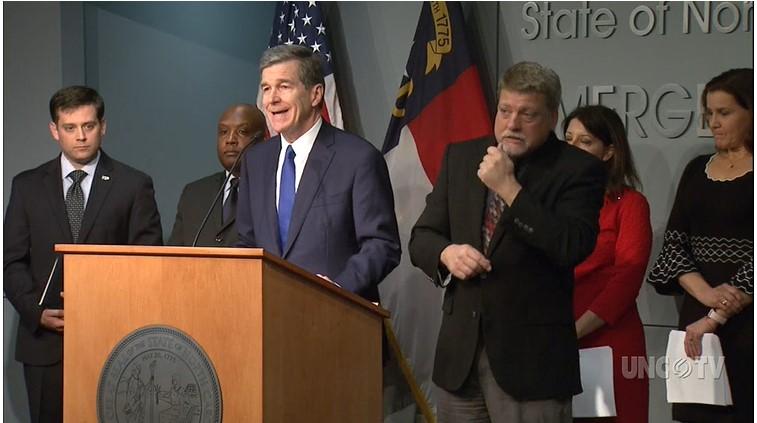
2 min read March 2020 — There are now seven confirmed coronavirus cases in North Carolina, prompting Gov. Roy Cooper to declare a state of emergency as leaders and health officials deal with the coronavirus outbreak. Of the seven people who have tested positive for COVID-19, six are from Wake County and one is from Chatham County, according to health officials. The declaration activates the Emergency Operations Center to facilitate the purchase of medical supplies, protect consumers from price gouging, and increase county health departments’ access to state funds. 

“The health and safety of North Carolinians is our top priority. We are taking the necessary steps to ensure that North Carolina is prepared and responding to this virus, and this order helps us do that,” Cooper said in a press release. “Though we are still in the early stages in North Carolina, time is a valuable resource and we must work together to slow the spread while we can.”

There are 120,944 global COVID-19 cases as of Wednesday morning, with 1,039 cases reported in the United States, according to the Center for Systems Science and Engineering (CSSE) at Johns Hopkins University. However, at this time, the risk to the general public in North Carolina is low, Mecklenburg County reported. 

As of Wednesday, Charlotte-Mecklenburg Schools is suspending all travel. The travel limitations apply to district-sponsored trips of any kind for staff or students. “The safety and care of our school family is my top priority as superintendent,” said CMS Superintendent Earnest Winston in a press release. “In situations like these, we come to a deeper understanding of how closely connected we are, and I thank you for your help in our efforts to be prepared.” 

Cleaning standards are being reinforced at schools and office buildings, while families are encouraged to keep children at home if they are sick, the school system reported. 

Similarly, American Airlines, the main carrier at Charlotte Douglas International Airport, also implemented travel limitations, cutting domestic and international flights due to decreased travel demand following the proliferation of COVID-19 cases globally. American Airlines will reduce domestic capacity in April by 7.5 percent and reduce international capacity for the summer peak by 10 percent, including a 55 percent reduction in trans-Pacific capacity. The airline is also suspending flights from CLT to Rome (FCO) and Milan (MXP), as there are over 10,000 confirmed COVID-19 cases in Italy, according to the Center for Systems Science and Engineering. 


To learn more, visit:

 https://www.mecknc.gov/news/Pages/Update-on-Novel-Coronavirus.aspx

https://governor.nc.gov/news/governor-cooper-declares-state-emergency-respond-coronavirus-covid-19

https://www.arcgis.com/apps/opsdashboard/index.html#/bda7594740fd40299423467b48e9ecf6

http://news.aa.com/news/news-details/2020/American-Airlines-Update-on-China-Flights-OPS-DIS/default.aspx


Tackling Affordable Housing in the Bay

Tackling Affordable Housing in the Bay

Writer: Max Crampton-Thomas

2 min read August 2019   Growth in the Tampa Bay region has been twofold, with a  significant boom in the economy and the population. As the population grows so does the need for more affordable housing options in the region. While there has been a notable increase in the development of luxury apartments and multifamily units, which are popping up all over Downtown, there is a notable deficit of affordable housing options. Mayor Jane Castor, her administration and community organizations like the Tampa Housing Authority recognize that they must work together to find- a solution for this problem.

Since her election in April, Mayor Castor has identified access to affordable housing solutions as one of her top priorities, as noted when she spoke with Invest:. “In reality, the most pressing issues in our community are transportation, affordable housing and workforce development.” She has since taken action to address the housing issue with the recent formation of the Affordable Housing Advisory Team as part of her “Transforming Tampa’s Tomorrow” transition. The role of the advisory team will be to ensure home ownership for all residents in Tampa regardless of economic status. It  will be one of five advisory teams guiding the mayor’s strategic vision for addressing key issues in Tampa Bay. 

One of the members of the Affordable Housing Advisory Team is Leroy Moore, the senior vice resident and chief operating officer for the Tampa Housing Authority. The Authority is not only focused on providing housing assistance to low-income residents. Its role has evolved over the years to better address the affordable housing issue in the region. Invest: recently spoke with Moore, who discussed how the Authority is addressing this need. “The Housing Authority has evolved to not only manage affordable housing, but also to redevelop this housing into real estate that functions as more than just a roof over someone’s head. We consistently ask ourselves what else does a community need? A community needs jobs, quality food and transportation accessibility, which brings in the need for collaboration with transportation agencies in the region. We can meet the needs of the community by developing housing, especially affordable and attainable housing, around accessible transit options. Great transit translates into better housing costs.” 

The Authority’s actions to tackle affordable housing include the redevelopment of a 28-acre superblock of public housing that will be known as the Encore District. In his discussion with Invest:, Moore spoke about the Authority’s approach to this development and how it differs from the original construction., “Seventy-five years ago, the Tampa Housing Authority developed a 28-acre superblock of public housing on the doorstep of what is now Downtown. Seventy-five years later, we are redeveloping that site and realizing that its potential today is far greater than what was ever imagined back then. Instead of just having a 28-acre single-use affordable housing community, we now have 12 city blocks of diverse development called the Encore District.” He continued: “Encore will be a LEED Gold neighborhood development community. All the buildings have a commitment to be LEED Silver or higher. We replaced the affordable and workforce housing and increased the number of affordable units on that exact same footprint. We are also adding other uses like hotels, museums, schools, market-rate housing and grocery stores all within the same 28-acre area.”

The need for more affordable housing is not an issue that will resolve itself and will only continue to manifest into a larger challenge as the population in Tampa Bay grows. The solution is not clear-cut, but community leaders like Mayor Castor and Moore are working to find actionable answers.  

To learn more about our interviewees, visit:

https://www.tampagov.net/


https://www.thafl.com/

Spotlight on: George Cretekos, Mayor, City of Clearwater

Writer: Max Crampton-Thomas

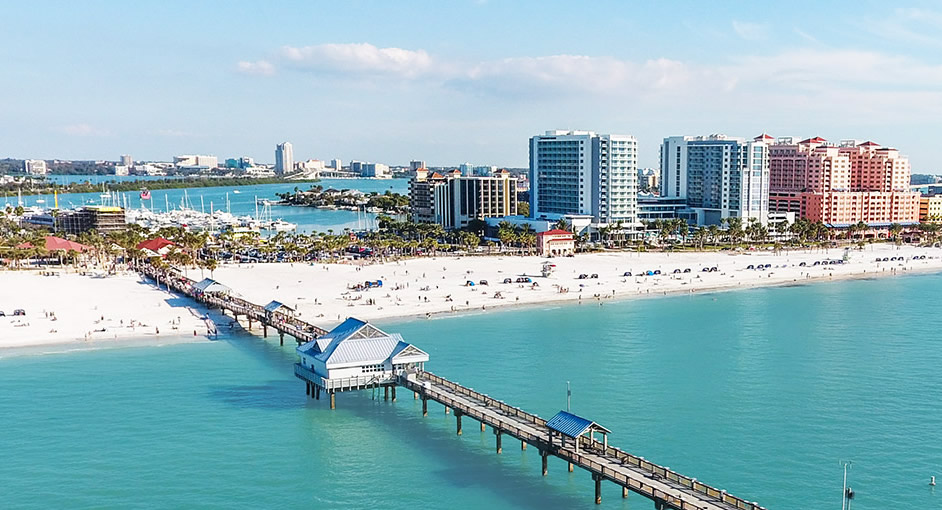
2 min read JULY 2019 — For the second year in a row, Tripadvisor awarded Clearwater  the distinction of having the best beach in the country. This comes as no surprise to the city’s 115,000 residents, who have long been stewards of their environment. With the population in the Tampa Bay region growing, that stewardship becomes even more important. 

Invest: Tampa Bay recently sat down with Mayor George Cretekos, who is on the verge of completing his second term. He discussed how the city is handling population growth, the challenges associated with it and how residents are at the forefront of environmental sustainability in Clearwater. 

How are Clearwater residents supporting environmentally sustainable practices? 

As I complete my second term, I appreciate how our residents and businesses have, on their own initiative, promoted sustainability and environmental stewardship.  Before there had been any talk about governments banning single-use plastics in the region, Clearwater’s businesses had started their own programs to stop using plastic straws. It is now common to find many restaurants in Clearwater that do not offer plastic straws or styrofoam to-go containers. This is a testament to how our residents are promoting sustainability and being good stewards of the environment.

How is the region handling the recent increase in population growth?

The region must have smart growth to make sure we are not only taking care of the environment, but also guaranteeing accessibility for our residents and visitors. We continually hear that we have traffic problems and at certain times of the year those problems can be exasperating. The population in this region needs to adapt to using alternatives like public transportation, which can be a better option than building more roads. We should model our transportation efforts to be like that of other major cities where reliable public transportation is an alternative.

What are the biggest challenges facing the city of Clearwater? 

Transportation and affordable housing are the two biggest concerns for the Tampa Bay area. A large percentage of the employees in Clearwater does not live in the city; if we can help provide affordable housing for these employees then the transportation problems could be eased. These individuals would not have to commute long distances into Clearwater, which in turn would help clear a significant amount of congestion on the roadways and emissions. My fellow mayors in the Tampa Bay region have realized that we may be separated by a body of water, but that doesn’t mean that our interests don’t run parallel. When one city does well then we all do well, so we should be working together to solve these issues.

To read more about our interviewee, visit: 

https://www.myclearwater.com/home