Miami Growing Political Profile

Miami Growing Political Profile

By Yolanda Rivas

June 2019

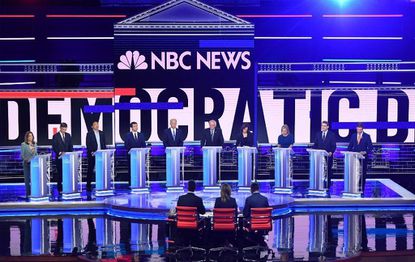
2 min read July 2019 — Miami grabbed the national spotlight last week when it hosted the first Democratic presidential debates. The city is already a popular destination for tourism and business, but events like these boost its political profile and create a trickle-down effect that has a broad and positive impact.

“Miami is a vibrant and dynamic city that reflects the values and diversity of the Democratic Party. I couldn’t imagine a better setting for our first debate,” said Democratic National Committee Chairman Tom Perez in a written statement regarding the event at the Adrienne Arsht Center for the Performing Arts. 

Miami has previously hosted presidential debates, which impact logistics, airport and hotel capacity. In March 2016, Republican candidates debated at the University of Miami’s BankUnited Center during the 12th and final Republican presidential debate. The city also hosted a Democratic presidential primary debate at Miami Dade College and the first of the presidential debates in 2004 at the University of Miami.  

These political events also benefit the educational institutions that host them. Usually, universities spend millions of dollars to host presidential debates. This has a direct impact on the local economy, with the involvement of subcontractors and others in the preparations for security and media. 

According to an article in USA Today, Lynn University, which hosted a 2012 general election presidential debate in Boca Raton, estimated the event generated a staggering $63.7 million in “earned media.” For example, the university estimated that some 4,000 media representatives attended the debate and spent $2.6 million while in town.

These events can also represent an enriched educational experience for students because a number of seats are usually distributed to university students and officials. As a debate site, an institution also enjoys heightened visibility and a chance to attract new students. 

While less obvious, another significant benefit is the ability of a city to capture the nation’s attention and potentially influence the election through the questions and topics discussed. Miami is a demographically diverse and coastal city, making it perfectly suited to raise issues of national concern, such as immigration and climate change, as happened at the Democratic debates. 

Miami’s rich culture, demographics and strong business environment make it a prime destination for political events. With the spotlight in hand, Miami not only bolstered its national stature, it provided an opportunity for the local community to shine, and potentially grow. 

For more information, visit:

Adrienne Arsht Center for the Performing Arts: https://www.arshtcenter.org/ 

University of Miami: https://welcome.miami.edu/ 

BankUnited Center – Watsco Center: http://watscocenter.com/eventpage.php?id=154 

Miami Dade College: http://www.mdc.edu/

A changing investment landscape

Invest: Miami speaks with Jose Parrilla, CEO & president of InvestQuest Partners

What were InvestQuest Partner’s most important successes and milestones for 2016?

We achieved many important milestones in 2016. From the business standpoint, we were able to open an important number of developments. Our primary business is buying, renovating and flipping assets. We wiped out over $10 million in liens held by the local municipalities and completed over 200 flips. Our success this year has allowed us to grow the company to 300 employees.

With the deceleration of real estate growth, what is the expected impact on real estate investment in 2017?

The current slowdown in the market is a temporary one. We strongly believe that Miami will continue on a path of long-term growth because of its history of continually attracting affluent investors. We are confident that in a two-year period we will be able to sell our new projects at similar or higher prices to the ones today. Even when you take into account that, for Latin American investors, it has become more expensive to invest in the U.S. due to the strengthening USD and that the proportion of foreign money in the market has decreased in the last few years, there have still been an increase in foreign investors with significant presence, such as those coming from Spain and Canada.

What has been the performance of the REO vs the short sale market?

The Real Estate Owned (REO) market has completely dried up. According to our data, which is very conservative, there are people in that market segment who are overpaying for properties. This might be related to some speculation in the market, with many players assuming that the market is slowly going to increase. However, our data suggests that we should be preparing for a slight downturn.

The opposite situation is happening in the short sale market. It is an important opportunity in Miami because it not only gives players a chance to help people by taking them out of a difficult situation offering “cash for keys,” but it also is the most lucrative investment in real estate because of its many revenue sources: commissions from the banks, commissions from the mortgage holder, and the property at a huge discount.

How can investors take advantage of the zoning in Miami?

The optimum zoning we are currently focused on is  T6-80, which allows the developer to build up to 12 stories with a density of 150 units per acre.  One of the main challenges for developers that are trying to build under Miami21 is compliance with the parking spaces that are required in order to be allowed to build the units. However, since one of our projects is near the border between Downtown and Brickell, we received the first permission to build our units without the required parking spaces. This shows that the city is evolving and adapting to a structure better suited for high population density.

To learn more about Invest Quest partners, visit their website at: http://investquestpartners.com/

A NEW FRONTIER: TRANSIT ORIENTED DEVELOPMENT IN SOUTH FLORIDA

A NEW FRONTIER: TRANSIT ORIENTED DEVELOPMENT IN SOUTH FLORIDA

When: THU MAY 11, 2017 7:30 AM

Where: VENUE TO BE ANNOUNCED BY APRIL 11TH


As South Florida’s popularity is on the rise so is population. With an influx of people, the need for transportation solutions continues to rise. More than ever before projects in South Florida that provide mobility options are being championed by the private development community and public sector alike.

Britweek – 4 Nations Cricket Tournament

When: Sunday, March 12th 10am – 4pm

Where: Central Broward Stadium, 3700 Northwest 11th Place, Lauderhill, FL 33311

The inaugral BritWeek 4 Nations Cricket Tournament.
With teams representing the UK, India, Pakistan and the West Indies.


BritWeek presents An Ocean Science Virtual Reality Experience

When: Thursday, March 9th from 7.00pm

Where: Villa Vecchia, 4821 Pine Tree Dr, Miami Beach, FL 33140

An exclusive evening celebrating the collaboration between British marine scientists  together with ANGARI Foundation on board their 65 foot research vessel.


Invest: Miami speaks with Alexandra Villoch, President & Publisher Miami Herald Media Company

Invest: Miami speaks with Alexandra Villoch, President & Publisher Miami Herald Media Company

While in other parts of the U.S., Hispanics may be considered part of a niche or minority market, in Miami-Dade County, the Hispanic market is the general market. Broadly speaking, Hispanics in Miami are highly entrepreneurial and more affluent, better educated and more technologically engaged than they may be elsewhere in the U.S.

A large portion of the Hispanic population in Miami-Dade prefers to speak Spanish. El Nuevo Herald attracts these Spanish-preferring Hispanics while the Miami Herald attracts the English prefer-ring Hispanics. We also have Hispanic readers who buy both the English-language Miami Herald and its Spanish counterpart El Nuevo Herald because the coverage of the two papers is quite different.

El Nuevo Herald focuses more on news and issues that pertain to Latin America, especially Venezuela, Colombia and Cuba, while the Miami Herald emphasizes local or national news with the U.S., even as its coverage of Latin America is renowned nationally and internationally. We even have differ-ent editorial perspectives for the two newspapers that hold distinct views as they serve different audiences. A perfect example: during the Florida gubernatorial elections, the editorial staff at Miami Herald backed candidate Charlie Crist, while those at el Nuevo Herald supported incumbent Rick Scott.

It is important to note that our Hispanic readership is not monolithic. For instance, there is a big difference demographically between digital and print consumption among our Spanish readers, as is the case with our English readers. Both El Nuevo Herald and Miami Herald digital readers skew younger, more affluent and have a higher education level than readers of the print version. Essentially, we are addressing a much different constituent and audience in the digital space in Spanish and English than on the print side. As Hispanics in the U.S. continue to grow its size and influence on culture, economics and politics, it will become extremely important to understand the nuances of this mar-ket, and Miami-Dade County will be ahead of the curve nationally because of its proficiency and experience catering to this demographic.