Cruising ahead 

Cruising ahead 

Carnival Corporation President and CEO Arnold Donald describes growth trends in the cruising industry and the advantages of being headquartered in Miami-Dade

What are the growth trends for Miami-Dade cruising?
In 2014, 22.1 million people worldwide took a cruise – representing a 4-percent growth over 2013 – and this figure is expected to reach 23 million in 2015. Carnival Corporation ships carried nearly half of all global cruising traffic in 2014, while the company saw 25 percent growth over the previous year. Miami-Dade drives much of the cruise activity in Florida – the cruising center of the U.S., with 14.1 million revenue passengers (7 million individuals). PortMiami’s $2 billion long-term masterplan to expand cruising facilities will only support that growth. The port broke a world record in fiscal year 2014, processing approximately 4.8 million multi-day cruise passengers.  In fiscal year 2015, the port expects to welcome 34 total ships from 15 cruise brands, which is an increase from 2014. With an increasingly global cruise market, the port’s expansion will help to keep some of the biggest ships across the industry home ported in Miami.
 
Carnival Corporation’s global headquarters are in Mi-ami-Dade. What are the advantages that this confers?
The advantages are numerous, including great weather, leading port operations, a solid customer base and close proximity to the Caribbean – by far the largest cruise market in the world. South Florida, therefore, enjoys a big advantage in its proximity and ease of access to one of the most beautiful parts of the world, with amazing itineraries and destinations.
PortMiami is one of the finest cruise ports in the world, with seven cruise terminals, on-port parking for drive-in customers and drop-off in front of each port for those arriving by taxi, shuttle or limo. Terminals D and E, each of which are 105,000-square-foot ultra-modern, three-story structures, can accommodate travelers sailing on some of the Carnival Corporation’s biggest ships. As part of the recent agreement Carnival Cruise Line signed with PortMiami to keep ships there through 2028, Miami-Dade County agreed to spend up to $10 million upgrading Carnival’s port terminals.
 
How do you see the cruise industry evolving?
With such a small percentage of the world’s population who has cruised, there is a tremendous opportunity available with first-time cruisers. About 50 percent of our addressable market has never cruised and 75 percent of that will consider cruising in the next five years. Attracting new cruisers to our industry – especially more socially conscious travelers and millennials – is the next big opportunity for all of us. The chief competition for cruising is land-based vacations, so as we better communicate our overall value, we can convince more new cruisers to vacation with us and exceed their every expectation when they are onboard.

Destination luxury 

Destination luxury 

Greater Miami Convention & Visitors Bureau (GMCVB) President and CEO William D. Talbert III discusses the growth of luxury tourism in Miami

What are the key trends in Miami tourism today?
Today Miami is one of the top luxury destinations in the world, which we couldn’t have said in the past, when we were just a local vacation spot. Miami is now in the same league as other global cities – London, Paris, Sydney, and Tokyo. With all the high-end hotels and the infrastructure we’ve developed – the cultural facilities, the airlift – we can support the growth in this segment. The advantage of being a luxury destination is that it makes us recession-proof; the luxury consumer travels during tough times, they shop and dine, so even when there is an economic downturn this segment continues to flourish.
 
Tell us about the profile of the luxury traveler. From which countries are they arriving?
We saw a record 14.5 million visitors in 2014. In 2013, for the first time in our history, we had more international visitors than domestic. No other city in the U.S. can say that. Those international visitors represented 70 percent of the visitor spend, while 96 percent of our visitors come by air. A third of all of our customers come from Latin America, with Brazil as our number one international market. It took Brazil 25 years to be-come our first billion-dollar international market, and within four years it will likely double to $2 billion.
Miami’s international community is a great attraction for foreign visitors and enhances the cultural offering. For instance, during the 2014 World Cup, Miami was one of the few cities in the world where you could find restaurants, bars and clubs, representing each of the nations competing in the Cup. During the event, in Miami, you could find match-viewing parties being hosted by Argentine grills, German and British pubs, Italian and Colombian restaurants.
 
In which markets does the GBCVB conduct outreach to attract more visitors to Miami?
We have offices in 46 cities around the world, including  India and China. In terms of opening new offices, we are looking to the Middle East, possibly Doha, Qatar. Doha allows us to better connect with Asia. Qatar Airways, which recently started direct flights to Miami, connects to 11 cities in India and seven in China. We are also presently working to establish relationships with other international carriers, including Emirates and Japan Airlines.
 
How do you balance the needs of the luxury segment with the affordable tourism market?
We focus on luxury, but the developments around town are quite diverse. You can never have too many luxury brands, but you are also seeing that different mid-range brands are coming in. The luxury segment drives the rest of the local tourism industry. People want to go where the rich and famous are, whether it’s movie stars, professional athletes, or captains of industry, so luxury becomes an important aspect of attracting all visitors to Miami.
 
How is the GMCVB working to promote the meetings, incentives, conferencing and exhibitions (MICE) segment?
We have staff dedicated to promoting the MICE market and that is also thanks to the growth in luxury tourism. New high-end hotels are be-ing constructed, such as SLS Lux and the EAST – both located in Brickell – and they will further add to the existing luxury hotel offerings in Miami.
We are also the exclusive sales agent for the Miami Beach Convention Center, which is currently undergoing renovation and expansion to foster more business tourism for the destination.
 
What are some of the greatest challenges facing Miami’s tourism sector today?
Streamlining procedures. Since 96 percent of our visitors come by air, we need to make it easier and more efficient for them to get to, from and through the airport. I’m referring here to the customs process. If a tourist is visiting from, say, Qatar, when he arrives to Miami, he has been on a plane for 15 hours. To spend that much time on a flight to come to a luxury destination, and have to then spend an additional two to three hours being processed at customs is not beneficial for the Miami brand, or brand USA for that matter.
We are continuously working with the U.S. government to address this matter, in particular how to improve staffing. Miami International Airport (MIA) has recently purchased automatic passport control (APC) equipment, which helps speed things up tremendously.
 
How would you comment on the quality of customer service within tourism and hospitality?
Tourism is the number one employer in this city, so jobs are very much at the center of what this industry is all about. To maintain our status as a top global destination, we constantly need to work on our customer service. Five years ago, the GMCVB implemented a number of initiatives intended to improve the quality of service in tourism-related industries.
We have a program, Miami Begins With Me, established in partnership with the Miami Dade College Center for Service Excellence, which provides service training to individuals and organizations. We partnered with MIA to establish the Miami Begins with Me Customer Service Training Institute at the airport to provide training for taxi drivers and airport employees.
 Customer service remains a key challenge for us because there is such a large transient population in Miami. On the other hand, the fact that we have so many five-star hotels and establishments means that those businesses set a precedent for service quality that trickles down to the rest of the sector.
 
Beyond the nightclubs and beaches, what are some emerging tourist attractions within Miami?
What is great about Miami is the city is constantly evolving. It is no longer all about South Beach, although the beaches are still a significant draw for tourists. Today we have places like Midtown, the Design District and Wyn-wood, neighborhoods that were previously warehouses and industrial lots, being converted into edgy, artistic hubs. These have become new attractions, not just for tourists, but also for locals, affirming Miami’s niche as an ideal place to live, work and play.
We are witnessing the re-emergence of a great downtown, with new buildings under construction and a rich offering in terms of dining, shopping, arts and entertainment, as well as our diverse heritage neighborhoods. What we must realize is this is not a zero-sum game. As new developments crop up, Miami’s attraction as a destination builds and the pie just keeps expanding for all involved.

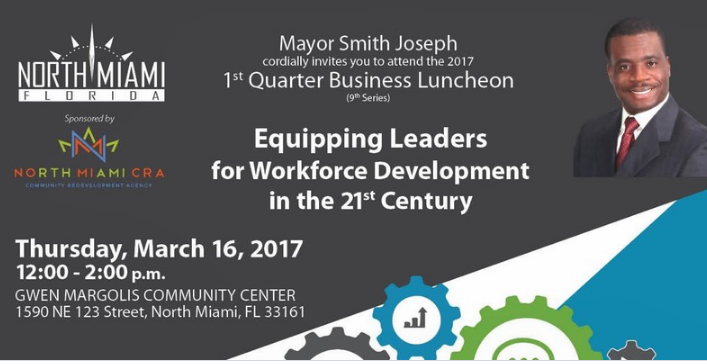
Mayor Smith Joseph – 1st Quarter Business Luncheon of 2017

When: Thu, March 16, 2017 12:00 PM – 2:00 PM EDT

Where: Senator Gwen Margolis Community Center, 1590 Northeast 123rd Street, North Miami, FL 33161

Equipping Leaders for Workforce Development in the 21st Century

Join The City of North Miami’s Mayor, Dr. Smith Joseph, for the 2017 1st Quarter Business Luncheon titled Equipping Leaders for Workforce Development in the 21st Century featuring Keynote Speaker Jeff Bridges, Chairman of CareerSource South Florida. Learn how local companies are redefining what it means to have a skilled and innovative workforce in the 21st century job market.

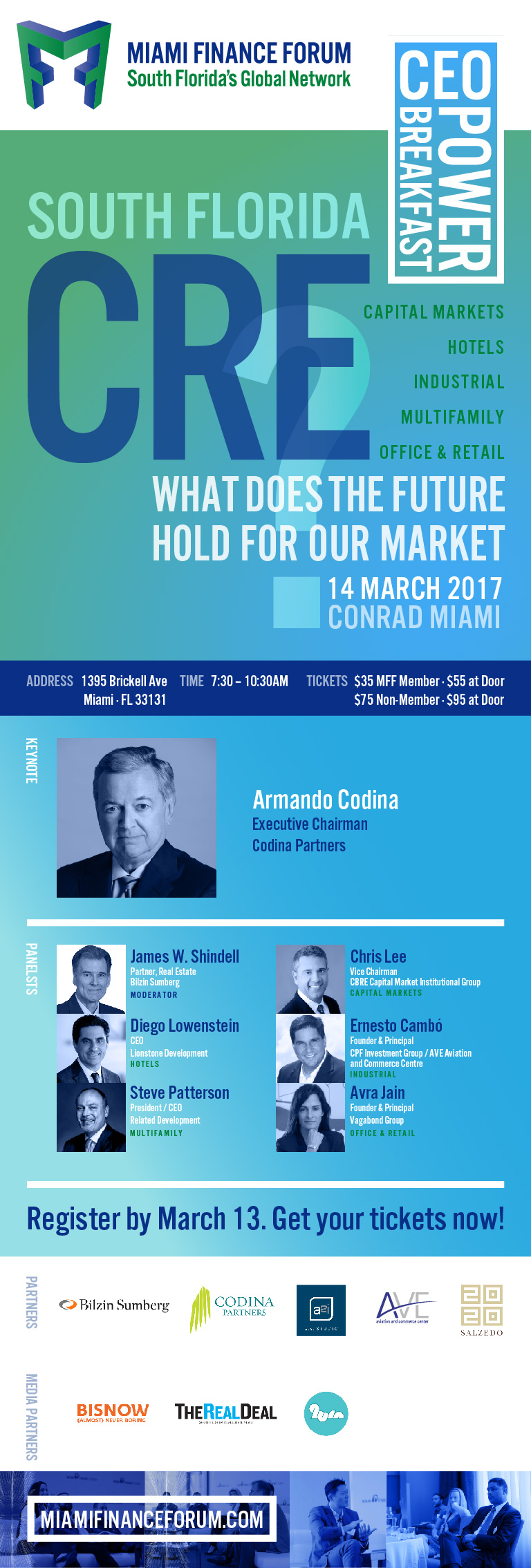
MAPPING MIAMI’S FINANCIAL FUTURE

MAPPING MIAMI’S FINANCIAL FUTURE

Key South Florida Leaders Driving Entrepreneurial and Business Success

This half day forum will provide insights into key business leaders instrumental in shaping the business and entrepreneurial landscape in South Florida.  The discussions will include commentary from successful women executives from diverse sectors along with an entrepreneurial panel sharing their personal journeys of business building.  Also, key note thoughts from global executives and business networking will round out the program.

For more information click here

MDX invests in Miami’s transport infrastructure

Invest: Miami speaks with the Miami-Dade Expressway Authority

With five projects being executed and seven others in the pipeline, the Miami-Dade Expressway Authority (MDX) is rapidly enhancing Miami’s road infrastructure. MDX, the entity that manages, maintains and funds improvements to five local expressways, and is funded only by tolls collected on the Dolphin SR 836, Gratigny SR 924, Airport Expressway SR 112, Don Shula/SR 874 and Snapper Creek SR 878, is executing important projects in order to improve Miami’s traffic conditions.

Even though partnerships with other public entities such as the Miami-Dade Department of Transportation and Public Works (MDT) and the Florida Department of Transportation (FDOT) have been essential to executing some of the current projects, MDX has been able to embark on these new projects because of the improvement in its funding system. Instead of just 50% of drivers paying, now all users pay for the portion they drive. This, combined with funding through bonds, has allowed MDX to adopt sensible policies to tackle traffic in Miami-Dade.

“The increase in revenue is because of three reasons: Everyone pays their fair share for the use of the road, the economy has grown, and the population has increased, resulting in higher traffic volumes and improvements that MDX has already made allows for increased capacity on its expressways.” Louis Martínez, Chair of the MDX Board of Directors, stated in December 2016. “When we made changes to our system in 2014, we promised to construct improvements that would save travel time for our customers. We are ahead of schedule in fulfilling this promise,” he added.

One of MDX’s major projects, the SR 836 Modernization from NW 57th Avenue to NW 17th Avenue, will include a diverging diamond interchange, also called a double crossover diamond interchange. This is a type of diamond interchange in which the two directions of traffic on the non-expressway road cross to the opposite sides. The project is scheduled to be completed in summer 2018, almost at the same time as the MDX SR 836 Interchange Improvements at 87th Avenue, another project currently under construction, will finish. MDX explains that the main purpose of the project is to improve traffic operations and safety of the SR 836 and NW 87th Avenue Interchange. A significant improvement will be the addition of a new flyover ramp that will provide direct connection from westbound NW 12th Street to westbound SR 836. This improvement will substantially reduce the congestion at the intersection of NW 87th Avenue and NW 12th Street.

In an earlier stage is the SR 836 Improvements from 17th Avenue the Midtown Interchange, which is being constructed in partnership with the FDOT and is expected to start construction by the end of this year.

The MDX SR 874 Ramp Connector to SW 128 Street is currently underway. It will provide alternative expressway access to the area, reducing congestion and providing additional connectivity and mobility to the rapidly growing area of southwest Miami-Dade County.

Finally, MDX will produce the Dolphin Station Park and Ride Transit Facility in partnership with MDT and the FDOT. The transit facility will support the Department of Transportation and Public Works’ SR 836/Dolphin Expressway Express Bus Service, provide a terminus or stop for several local bus routes serving the Dolphin Mall and the cities of Sweetwater and Doral, as well as serving a potential future east-west commuter rail service on the CSX line.

Juan Toledo, Deputy Director and Director of Engineering commented, “Our projects are rooted in core principles of improving transportation by investing in key pieces of infrastructure improvements, introducing reliable and safe emerging technology, and providing different options within the transportation corridors.”

To read more about the Miami-Dade Expressway Authority’s work, visit their website at: http://mdxway.com


Healthy changes

Healthy changes

Florida Blue Market President Penny Shaffer discusses the challenges and opportunities presented by the Affordable Care Act (ACA)

How has the ACA impacted the relationship between health care providers and insurance companies? 
ACA focuses mostly on access and does not mandate enough changes on the delivery side, yet the only way to provide affordable access is to have the right payment model in place and share accountability among all the players. Rather than maintain the current fee-for-service model, we need to strive for better health outcomes. Florida Blue has established over seventeen Accountable Care Organizations (ACOs) across the state and 2,500 patient-centered medical homes, with over 4,500 physicians participating. These arrangements allow physicians and insurance companies to share analytics regarding a set of patients. Doctors are rewarded for their patients meeting certain health standards. keeping the focus on wellness more than illness.
 
How has the implementation of ACA created challenges for businesses in South Florida?
It makes affordability a challenge, particularly in South Florida. We are a community of small businesses. Today these businesses are trying to figure out where to go from here as a result of the law. Do they offer insurance or do they let employees go to the individual market where they could get a subsidy? Miami is arguably the most expensive setting for health care in the U.S. This is primarily due to our large aging population. This market has a high concentration of medical specialties, with fewer primary care providers. Moreover, Miami has one of the highest concentrations of Medicare fraud, which further drives up the cost of health care. Finally, we have a large uninsured population, which is in large part comprised of immigrants from countries with socialized medicine, and are therefore unaccustomed to having to procure insurance for themselves or their employees.
 

How would Medicaid expansion affect South Florida?

Nearly 700,000 people in Florida are in the coverage gap, meaning that they make too much for the state’s current implementation of Medicaid and too little to qualify for subsidies on the exchanges. The majority resides in South Florida, and inevitably we have to fix this gap.

At the state level, what policy developments will have the greatest bearing on health care in the near term?

New legislation would expand the availability of telehealth services, which would provide more convenient access to health care services, particularly to Floridians in rural areas or areas with physician shortages. Proposals to modify prior authorization rules and step therapy protocols must strike a balance between the management of medical costs and the treatment needs of the patient along nationally-recognized guidelines. Covering more South Floridians should result in lower health care costs as uncompensated care is decreased.

People-centered

People-centered

Baptist Health South Florida President and CEO Brian E. Keeley discusses South Florida’s unique health care needs and strategies to tackle rising costs

What are the unique demographic and epidemiological trends in South Florida, and how have these driven growth in the health sector?
The most conspicuous trend is the same one driving growth on a national basis: people are getting older. I call it the demographic tsunami.  Baby boomers are all turning 65, and the utilization of health care services for people over 65 is essentially twice as that for people under 65.
In South Florida, we also have a high percentage of uninsured individuals – around 30 percent. Hopefully, because of the Affordable Care Act (ACA), it will fall significantly. When people have insurance, demand goes up; without insurance, these folks don’t have access to, or they don’t use, health care services.
Epidemiologically, we see a higher incidence of diabetes here in South Florida relative to the national average. In part, this trend is informed by the area’s large Latin American and Caribbean population.
 
Miami-Dade’s growing international profile has created growth opportunities in medical tourism. How significant is medical tourism for Baptist Health?
Baptist Health does well in the international market, particularly when it comes to the Latin America and the Caribbean, where we focus our international outreach efforts. Patients from these countries come to Miami-Dade to seek medical treatment because of its proximity, and this market’s abundance of specialists that address the specific needs of this population. Our main focus in the international market, like the domestic market, is wellness and disease prevention. For Latin Americans, this means diabetes and obesity education because these diseases disproportionately impact the region. We provide diabetic educators and dialectologists for this purpose.
Because international patients tend to pay in full for their for their medical treatments, this segment generates significant revenues for area hospitals and other health care facilities engaged in medical tourism. Thus, although medical tourism comprises less than 5 percent of Baptist Health’s business, it probably contributes around 5 percent to our bottom line.
 
What are the key strategies necessary to care for a large contingent of international patients?
Baptist Health has one of the largest international programs in the U.S. We see around 12,000 patients a year, competing with the likes of the Cleveland Clinic and Johns Hopkins. We are long-term players in this space – we’ve been in it for 20 years. The reason we have been so successful is that, unlike other clinics that may provide service in multiple locales, our focus is honed on Latin America and the Caribbean. We know that market very well, and we benefit greatly from the high volume of direct flights to and from Latin America. In South Florida we have a large staff of bilingual and trilingual folks who can care for these patients, and we also have representatives working in various countries throughout the hemisphere.
What are the notable trends in health care-related employment in the South Florida market? 
Our provider community has a very handsome and generous supply of specialists and a deficiency of primary care physicians. This situation contributes to higher utilization, as does excessive and unnecessary medical testing.
 
 
What are the greatest challenges facing South Florida’s health sector?
The real problem with health care in the U.S. is not quality, nor is it access – everyone has access because the federal government has the EMTALA (Emergency Medical Treatment and Active Labor Act). The problem is cost, and if left unchecked, I think we’re go-ing to bankrupt the country.
Fee for service, in my estimation, is the single number one foundational problem of cost. We have too many unnecessary surgeries and procedures – as high as 30 percent, which is a huge number – and it’s all driven by fee-for-service. Under this model, the more you do, the more you get paid. We’ve got the incentives misaligned. This is a cultural matter that needs to be changed.
 
How can rising costs be addressed? What are best practices from Baptist Health’s experience?
We have been successful in meeting our goal to reduce health care costs below the rate of inflation. This year saw the lowest rise in our 50-year history. Inflation was around 3.5 percent to 3.6 testing, whereas our admission costs increased by only 0.9 percent. This was not the result of one big change, but a thousand small ones.
That said, transitioning away from the fee-for-ser-vice model is key. We are very patient-focused, while fee-for-service is not. It is not only an excessive and costly model, but also deteriorates the quality of care. We want to pay our doctors in capitation – providing them incentives for promoting good health outcomes and keeping their focus on wellness and prevention. To ensure we appropriately leverage the doctors, we complement them with highly trained nurse practitioners along with dieticians and physical therapists. We have been hiring a high number of primary care physicians to bring balance to a system that is so specialist-heavy.
We have been experimenting with a number of alternative care models that cater to the needs of the patients. For instance, they open early and close late, so as to eliminated their having to go to urgent care or the emergency room “after hours” for minor symptoms simply because their doctor’s office was not open.
What is Baptist Health’s strategy for growth and expansion?
Baptist Health is the fastest-grow-ing organization in South Florida and the largest private employer, providing jobs to 16,000 people. When people look at our growth, they say, “well, you have all of these hospitals,” but in fact, our growth has been on the outpatient side! We have 50 outpatient centers and buildings – that’s quietly how we have been expanding.
We are transitioning from a high-cost environment, anchored by acute care hospitals, to one based in outpatient care, which is the bulk of our business today.
From here, the next transition is to the doctor’s office, where we will grow primary care, and eventually back to the home, as advances in telemedicine – both on the technology and regulatory sides – continue.
In 2014, we finalized plans to build a $430-million world-class cancer treatment and research center, which will have the latest technology, including proton therapy. The center will conduct, not just bench, but also phase II and phase III – or translational – research. We are building a hotel for cancer patients and family members, and a wellness center too. This is the largest project we’ve undertaken. There are only 18 such facilities in the world – none in South Florida, Latin America or the Caribbean. Once the center opens, local patients and those from Latin America will not need to go to New York or Houston for treatment.

Community focus

Community focus

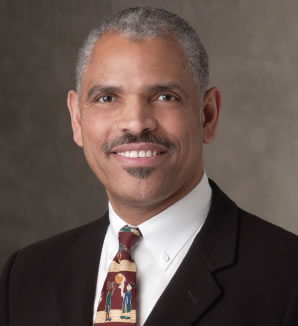
Wells Fargo South Florida Region President Joe Atkinson discusses the importance of community for large banks and small business alike

What are the notable growth trends in South Florida?
Small business is the engine that drives South Florida, and we are excited to be part of what’s happening here. Over 90 percent of businesses in this market are small and medium enterprises (SMEs). For Wells Fargo – a leading bank in South Florida in terms of deposits held, as well as the number-one small business association (SBA) lender of loans under $100,000 – the importance of SMEs to our bottom line cannot be overstated.
 The sectors exhibiting the most growth in this mar-ket are hospitality, construction, and those providing products and services to Latin America. In South Florida, Wells Fargo has been growing in small business banking – this is where we have been hiring the most personnel. We are also paying attention to a number of up-and-coming areas. For instance, we are seeing great growth potential in Doral and looking to expand our reach to that market.
 Miami-Dade is a highly dense market, and understanding that dynamic is key. If you drive by any one of our streets you will see small businesses clustered together in a fairly small space. That is a good indicator of both the professional and community growth that has led to a very large and stable deposit base in South Florida from a community and retail banking perspective.
 
How has post-recession lending reduced risk, while still providing adequate financing for homebuyers?
We have learned a lot from the Great Recession. We are better capitalized today and more cautious when it comes to mortgages, where in the past we may have been too aggressive. To do this we have had to remain close to our customers to make sure we understand their needs. Moreover, we have invested greatly in ensuring greater adherence to compliance procedures.
We also recognize that the density and growth of the market is a challenge to affordable housing and that we need to be proactive in helping provide housing options through community partnerships. For example, Wells Fargo has provided a significant investment to finance a 158-unit, low-income affordable housing project in Overtown.
 
What innovations have area banks implemented to adapt to an increasingly digital marketplace?
We hear that brick-and-mortar banking is dying, but the reality is that it is not going to go away. From this perspective, we are looking at developing technologically functional, eco-friendly neighborhood branches that integrate online, text and mobile banking technologies that can provide access to customers when they need their money, when they want to borrow and when they want advice, outside of normal business hours.