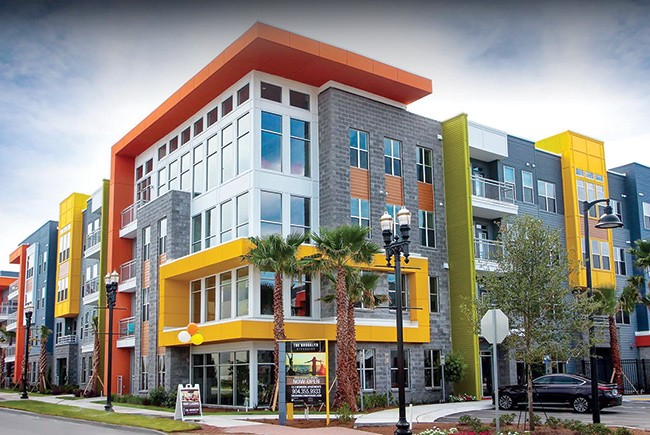
South Florida Collective Combats Gentrification in Palm Beach

South Florida Collective Combats Gentrification in Palm Beach

By: Sara Warden


2 min read November 2019 — As the 2018 federal tax code kicks into effect, capping deductibility of state and local taxes, demand has skyrocketed for luxury real estate in low-taxing states such as Florida. In the third quarter of 2019, the median price for a luxury home in Palm Beach tripled on the year to $21 million compared with $7.7 million in the same quarter of 2018.

As luxury house prices increase, single family and condo prices are also going up, according to a report by real estate appraisers Miller Samuel. In 3Q19, average sales prices for a condo reached $418,849, up 4.4% on 3Q18, and for a single family home the average price was $11.4 million, up 121.6% on the year. Tellingly, average price per square foot was up across the board, at $1,468/ft2 for a single family home during the quarter compared with $1,363/ft2.

The area is quickly gentrifying, with the Virgin Trains USA express service that runs through the county also pulling up house prices and pushing down affordability. In this environment, creating affordable housing for the residents of Palm Beach becomes ever more pressing. Now, the public and private sectors are joining forces to take action and create the South Florida Housing Link Collaborative, an ambitious affordable housing project. 

The project will target the route of the Brightline, deploying a $5 million investment by JP Morgan Chase to upgrade existing units and build new, more affordable accommodation. “Transport is the biggest expense after housing,” said Mandy Bartle, executive director of the South Florida Community Land Trust (SFCLT), to the Miami Herald. “We decided to hone in on this corridor because the people who most need public transit are a lot of the folks who already live in these areas near the railway and are the most likely to get pushed out by gentrification.”

As well as the $5 million in direct investment in the project, it is expected to garner $75 million in external capital from both the public and private sectors. Joining the SFCLT is the Community Land Trust of Palm Beach County, nonprofit Enterprise Community Partners, Florida Community Loan Fund, and the Solar and Energy Loan Fund (SELF). SELF provides small loans to homeowners for solar energy or hurricane-resilience technologies, providing $10 million worth of loans in their 10 years in business.

Duanne Andrade, the chief financial officer at SELF, said in an interview with Next City that those living on the path of new transit projects are often the most vulnerable to gentrification. Cindee LaCourse-Blum, executive director of the Palm Beach County CLT, added that climate change compounds the problem. 

“Housing and transportation eats up the majority of incomes in Palm Beach County, in addition to the risks that we are seeing with climate change and sea-level rise and a lot of people coming back into the urban corridor and gentrifying those neighborhoods,” she said to the same publication. “What I’m hoping to see is that residents of these communities have access to safe, affordable, resilient housing, and they’re not pushed out of their neighborhoods.”


To learn more about our interviewees, visit:

http://southfloridahousinglink.org/

https://www.millersamuel.com/

https://southfloridaclt.org/

https://cltofpbc.org/

https://www.enterprisecommunity.org/

https://fclf.org/

https://solarenergyloanfund.org/

How Broward is Solving its Transportation Troubles

How Broward is Solving its Transportation Troubles

By Max Crampton-Thomas

4 min read October 2019 —  For over a century, the car has been America’s top transportation choice when getting from point A to point B. As the population in the United States has grown exponentially year over year, so has the dependency on these vehicles, which has led to worsening transportation issues like congested roads, air pollution, traffic accidents and in some cases fatalities. Throughout South Florida, in this case Broward County, the negative effects of the population’s dependency on single-occupancy vehicles are rampant throughout the region. While these issues pose a major challenge to Broward, there is hope as the younger generations are looking to avoid the stress of car ownership, and many community leaders and organizations are making a push toward better mass transit and alternative transportation options.

While these are not all new ideas, in the last couple of years the emphasis for Broward has become truly exploring and executing these ideas. This starts with the  30-year Penny For Transportation Surtax that was passed last November and is set to generate billions of dollars toward improving transportation and mass transit options throughout the county. Invest: recently spoke with Monica Cepero, deputy county administrator for Broward County, who discussed what the community could expect from the revenues generated by the tax. “This sales tax is set to generate about $16 billion over the next 30 years, and will be used in the more immediate future to improve and modernize public transit services. Our long-term plan for those funds is focused on creating connectivity, extending roadway capacities, multimodal improvements and improving transportation facilities and service.”

Invest: also spoke with Gregory Stuart, executive director of Broward MPO, about the near-term changes that could be expected from the revenues collected from the tax. “Realistically, the immediate changes aren’t going to result in construction; we are focusing on enhancing the traffic signalization program. This includes a coordination between the traffic lights, people’s vehicles and installing smart communication equipment. Another immediate change that has happened already but which we’re not going to notice for about another year, is the county transit agency’s purchase of another 130 buses. Considering they are operating a fleet of about 300 buses right now, this is a one-third expansion and a significant increase in the bus system,” he told Invest:

While the tax is going to be a huge benefit for transportation in the region, a change in mindset is another factor impacting how people get around. One option is the Tri-Rail, which is celebrating its 30th year servicing the South Florida community. Tri-Rail Executive Director Steven Abrams spoke about how it is benefiting from the changing mindset toward mass transit in the area. “South Florida is a tourist and service-related economy, and these individuals, like waiters or construction workers, cannot work from their homes. We have people coming from all over the world who are used to rail transportation in their countries, and they are feeding into our system. Our roads are also just becoming so congested. It used to be that our ridership would principally, and almost exclusively, fluctuate with gas prices, but now that  gas prices are stable and dropping, we still have people riding our system because ultimately it is the overabundance of cars on the road that is urging them to seek alternative transportation.”

Abrams also spoke to how Tri-Rail has improved and updated its operations over the years to encourage use by a larger population. “Over those 30 years, we have improved our service, added more trains, added weekend and holiday service and added connections to the three airports. We are a transportation system that has become popular over time and we have really embedded ourselves in the tri-county area.” 

The other popular train in South Florida is also the newest mass transit option for the region, Virgin Trains USA. Running through the three counties of Miami-Dade, Broward and Palm Beach, the train is looking toward the future by connecting the three counties with Orlando and an eventual Tampa Bay stop as well. 

Patrick Goddard, president for Virgin Trains USA, discussed with Invest: how it wants to be a catalyst for transit change in South Florida. “We are reinventing train travel in America, so there are always going to be challenges, but none that we have not been able to overcome so far. The advent of this project has awakened a desire and a curiosity within the municipalities to recognize the full potential for mass transit in South Florida. We are solving the challenge in Florida of medium-haul travel. Airlines take care of long trips, while rideshare, motorized scooters and buses take care of short ones. There has always been this gap with the 200- to 300-mile distances that are too short to fly and too long to drive. By introducing an option like this, it encourages people to leave their cars at home and start using a more environmentally sustainable means of transit.” 

A key factor in remaining economically sustainable is having good transportation and mass transit options. As Broward County continues to develop into an economic powerhouse so to must its transportation, and with changing mindsets and push from community leaders the future looks bright. 

To learn more about our interviewees, visit:

https://www.tri-rail.com/

http://www.browardmpo.org/

https://www.gobrightline.com/

https://www.broward.org/

Face Off: Tampa’s Transportation Task Forces

Writer: Max Crampton-Thomas

4 min read September 2019 Whether it is Hillsborough, Pasco or Pinellas County, transportation issues seem to plague the entirety of this growing region. Mitigating these challenges requires innovative thinking and collaboration between the community, local government and both public and private organizations. Invest: Tampa Bay recently spoke with Beth Alden, executive director for the Hillsborough Metropolitan Planning Organization, and Whit Blanton, executive director of Forward Pinellas. These two organizations, whose primary focus is addressing the transportation and transit issues in the Tampa Bay region, discussed how they are gauging community needs in regards to these issues, facilitating better transit options and how they are turning dollars into solutions.

How do you gauge the community’s needs in regards to new transportation options?

Beth Alden: We have been engaging the public with an online survey, which is an interactive, gamified survey to ask folks about their priorities in regards to transportation. We received 5,200 responses, and it is amazing how many people are saying that they want a better rapid transit system. We have also discovered that they are very interested in reusing the freight rail tracks. That would require an agreement with CSX, which owns those tracks, but it’s a very underutilized asset. There’s no freight rail track between Downtown Tampa, the airport and the Westshore Business District, and it will take some extra steps to create that.

Whit Blanton: Our challenge in Pinellas County is that we are not growing like Pasco, Hillsborough, or Manatee County. We are expected to add about 90,000 people by the year 2045, which is a small fraction of what the other counties are expected to have. We have to plan and think differently. We have a situation here where the average new worker in Pinellas County is almost 50 years old, so we are not attracting young workers, except maybe in St. Petersburg, but most young people can’t afford to live there. Our strategy is really aimed at the future of our workforce, how do we draw talent and how do we retain this talent. We believe the solution is investing in housing and better mass transit services.

How are you facilitating better transit options?

Alden: In regards to transit, having some form of passenger rail system or rapid transit system would be one way we could do that. The important point with a rapid transit system is that we provide a way for it not to get stuck in traffic, so we need to provide some space for it to run and get out of traffic. We can do this with our bus system by providing special bypass lanes for buses where there is room on major roads. The walk and bicycle infrastructure is really important as well. People do not realize how many trips they make that are less than two miles long. If there are safe ways to walk or bicycle, then they do not necessarily have to be putting another car on the road to make that short trip. This also relates to our Vision Zero project, which is the vision of zero traffic deaths in Tampa Bay.

Blanton: ITS (Intelligent Transportation Systems) 2.0 is our plan for moving toward more intelligent transportation systems. Since the early 2000s, we’ve done a good job of implementing smart signals for moving traffic, responding to hot spots of congestion and facilitating traffic flow.  ITS 2.0 is intended to reimagine what the next phase of that investment is going to look like, which will focus more on real-time information and also ensuring the safety of bicycling and walking. Our advanced traffic management system has been focused on moving cars through intersections and keeping the flow going, but the next phase will include recognition of pedestrians at crosswalks. We also have an integrated transit fare payment system, called Flamingo Fares, that has been under development for a couple of years. That should go live in the next year. It will be a one-fare payment that can be used all over the region, whether someone is in Hillsborough or Pinellas County.

What specific plans are being implemented to move transportation development forward?

Alden: We will start with the essentials: resurfacing, safety and smart traffic signal projects. Almost half (the new Hillsborough transportation tax) is for transit, starting with expanding the bus service so it runs on evenings, weekends and often enough that you do not have to spend an hour waiting for a transfer. This is an amazing opportunity to implement the changes we have been planning for years. There are many more exciting projects in the pipeline. We finally have the resources to make the changes that the community wants to see in Tampa Bay.

Blanton: The Gateway District is our economic engine in Pinellas County. It is where the St. Pete-Clearwater International Airport is located, and there are a significant number of manufacturing and office jobs in that area. The challenge is that it is a loose and segregated type of development that is in need of an update. The Gateway is in four different jurisdictions, so it can be hard to design a cohesive plan for that area. We asked all four local governments, Pinellas Park, St. Petersburg, Largo and Pinellas County, to contribute $100,000. Forward Pinellas then put in $100,000 and the Department of Transportation put in another $500,000. With all this funding, we were able to put together a million-dollar master plan that is about to be finished. It is a reimagining of how the Gateway will develop in the future and focus on sustainable development because a lot of the gateway is in a coastal, high hazard, flood-prone area where businesses and potential development are vulnerable. The plan addresses how we are looking at higher density development to support transit in that area because we need to get our workers between the counties.


To learn more about our interviewees, visit:

http://forwardpinellas.org/

http://www.planhillsborough.org/